After Australia Group, NSG next frontier for India

After gaining entry to two non-proliferation groups, MTCR (Missile Technology Control Regime) and the Wassenaar Arrangement, India has become the 43rd member of another, the Australia Group (AG). With this membership India is expected to further push its demand for an entry into the NSG (Nuclear Suppliers Group) that has been stalled due to Chinese protests.
“India’s entry into the Group would be mutually beneficial and further contribute to international security and non-proliferation objectives” India’s External Affairs Ministry spokesperson Raveesh Kumar said in a statement.

Read More

Modi to showcase India Growth Story at Davos

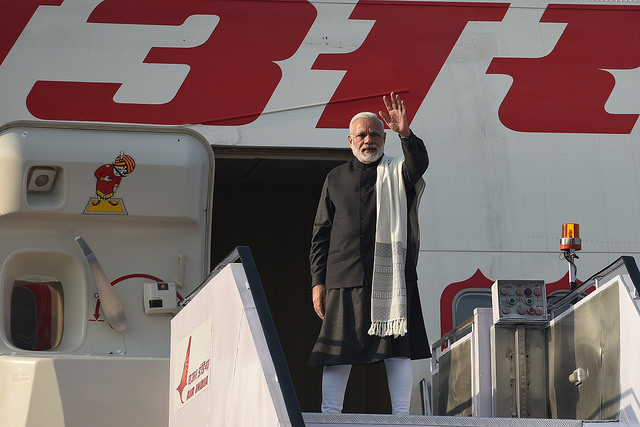
Buoyed by India’s growing economy and its rising global profile, Prime Minister Narendra Modi is poised to pitch the India growth story to international political and financial elite at the World Economic Forum in Davos.Mr Modi’s overarching message at Davos will be “India is open for business,” also the theme of the promotional campaign India has launched in Davos. Mr Modi will speak on the theme for the 2018 WEF, “Creating a Shared Future in a Fractured World,” and India’s role in the world. In his plenary speech, PM Modi is expected to highlight pathbreaking economic reforms taken by his government which have led to enhanced ease of doing business. India jumped 42 places in the World Bank’s Ease of Doing Business last year.
“In recent years, India’s engagement with the outside world has become truly and effectively multi-dimensional covering the political, economic, people to people, security and other spheres… At Davos, I look forward to sharing my vision for India’s future engagement with the international community,” Mr Modi said ahead of his visit to the picturesque Alpine town of Davos that holds the annual meet.

Read More

26/11 Memorial: Baby Moshe & Netanyahu revisit horror and hope 

More than nine years ago, when terrorists opened fire at Nariman House, it was a miraculous escape for two-year-old ‘Baby Moshe’ who was rescued by her Indian nanny Sandra Samuel. He has, since then, come to represent a story of tragedy, love and hope, marking an emotional connect between India and Israel. It was a moment of joy when the Jewish Chabad House, popularly known as Nariman House, hosted Israeli Prime Minister Benjamin Netanyahu and eleven-year-old Moshe Holtzberg for the unveiling of a state-of-the-art Living Memorial to commemorate the victims of the 26/11 Mumbai terror mayhem.
“What happened here represents the polar opposites of love and hate, the hatred perpetrated by the terrorists, but it also expressed tremendous love. The love of your parents Gabi and Rivky to you Moshe, and the love that is expressed by the Chabad House here in Mumbai and the love that is expressed by the embracing and loving attitude of the Chabad emissaries around the world which embraces and provides a loving home for every Jew around the world,” Mr Netanyahu told Moshe, who was accompanied by his paternal grandparents, Nachman Holtzberg and Frieda Holtzberg, maternal grandparents, Shimon Rosenberg and Yehudit Rosenberg, and uncle Moshe Holtzberg. His Indian nanny, who was awarded the title of ‘Righteous Gentile’ by Israel as the highest award presented to non-Jews, was also present at the occasion. Moshe, who now lives with his grandparents in the Israeli city of Afula, also read out a welcome speech for the Israeli prime minister.
Still bearing the bullet marks, Nariman House was where Moshe’s parents Rabbi Gavriel and Rivka Holtzberg lived.

Read More
Netanyahu pitches for India-Israel alliance of democracies

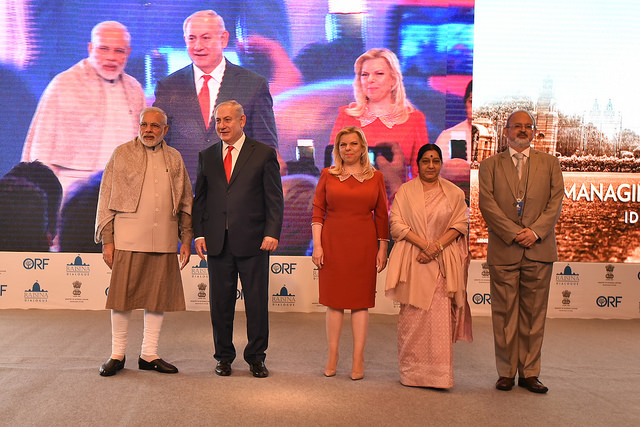
Underlining the civilizational and democratic connects between India and Israel, Benjamin Netanyahu, in his speech at the third edition of the Raisina Dialogue talked about the need to build power in an increasingly insecure world.“The weak don’t survive. The strong survive. You make peace with the strong. You ally with the strong”, he said like a true realist.
The Israeli leader outlined four types of power- military, economic, political and the power of values- that democracies like India and Israel should focus on. Therefore, building submarines, cyber capabilities, science and technology, interceptors are an essential component of the developmental goals.

Read More

Business Bonding: Fusing India’s size & scale with Israel’s sharpness & edge

India-Israel economic relations are poised for a decisive transformation, with the fusion of India’s size and scale with Israel’s sharpness and edge.Pitching economic ties onto a higher trajectory, India and Israel jointly launched the ‘I4Fund Call for Proposal’ website as part of the maiden call for the joint research and development (R&D) initiative. Under this $40 million fund, both sides will pursue technological innovations in areas such as water, agriculture, energy and digital technologies and create a support structure to convert “know-how” into “show-how”.
Speaking at the India-Israel Business Summit in New Delhi, which included 100 delegates from 74 Israeli companies, India’s Prime Minister Narendra Modi praised Israel’s “remarkable spirit of innovation, enterprise and perseverance” and underlined the shared commitment to connect the talent pool of both sides towards achieving path-breaking technological advances.

Read More

India, Israel map promising future amid Modi-Bibi bonhomie

India-Israel relations moved onto a higher trajectory on a crisp wintry afternoon in Delhi as the two countries signed nine pacts in diverse areas and their leaders speaking in one voice about scaling this vital partnership to new heights.
Hailing it as a historic moment in the relationship between India and Israel, India’s Prime Minister Narendra Modi and Israeli Prime Minister Benjamin Netanyahu renewed their shared commitment in taking their multi-faceted partnership to a wholly different level by fusing Israel’s technological prowess and innovation with India’s skills and ingenuity.

Read More

Netanyahu in India: Modi hug & soaring hopes

Hugs, personal bonding and effusive sentiments about India-Israel relations marked the first few hours of Israel’s Prime Minister Benjamin Netanyahu’s maiden trip to India.In a special gesture, India’s Prime Minister Narendra Modi went beyond official protocol to personally receive Israeli Prime Minister Benjamin Netanyahu at the Delhi airport. Mr Modi’s trademark hug and warm expression of friendship set the tone for six-day visit of the Israeli leader to India. Mr Netanyahu is leading a delegation of 130 businessmen from 102 Israeli companies and expects to take relations between the two nations together with the Indian leader to “new heights”.
“Indian Prime Minister (Narendra) Modi is a close friend of Israel and of mine and I appreciate the fact that he will accompany me on extensive parts of my visit,” Prime Minister Netanyahu said just before leaving for New Delhi.After the arrival the leaders headed for a ceremony to rename Teen Murti Chowk in central Delhi as Teen Murti-Haifa Chowk, in memory of the Hyderabad, Jodhpur and Mysore Lancers who carried out a brave assault to liberate the Israeli port city of Haifa during the First World War.

Read More

With China on mind, US envoy pitches for economic, military ties with India

Amidst shifting geopolitical equations in the Asia-Pacific region, US Ambassador to India Kenneth Juster has called for forging a robust strategic economic partnership with India and pitched for enhanced defence collaboration across the spectrum.In a defining speech on India-US relations, organised by Carnegie India and the US Embassy in New Delhi, Mr Juster projected the growing importance of India-US ties and the need to “build upon this foundation in a flexible but purposive manner”.The US ambassador’s big-picture presentation of India-US relations comes ahead of a likely meeting later this month between India’s Prime Minister Narendra Modi and US President Donald Trump on the sidelines of the World Economic Forum in the Swiss resort of Davos.
Economic ties through strategic lens
Proposing a Free Trade Agreement with India in future, the ambassador pointed out that India could be an alternative for US companies exiting China. He also assured that US President Trump’s call of “America first” and Indian Prime Minister Modi’s “Make in India” initiatives are not “incompatible” since mutually beneficial investment in each other’s markets increases the prospects of economic interaction and a robust trade leading to the technological collaboration and creation of jobs. While India-US trade has grown from $20 billion in 2001 to $115 billion in 2016, the trade deficit in favour of India stands at $30 billion and many US companies are unhappy with the protective barriers put in place by India.
“Increased heft in our economic relationship would necessarily provide a broader and deeper, long-term U.S. commitment to India and the Indo-Pacific region. This would complement our growing defence and counter-terrorism partnership, and moderate any policy differences that might arise along the way,” he said.

Read More