
The Spectre of ISIS: Trinidad’s Unfolding Jihadi Nightmare
“You now have a golden opportunity to do something that many of us here wish we could do right now. You have the ability to terrify the disbelievers in their …
Read More
Global Indian News
“You now have a golden opportunity to do something that many of us here wish we could do right now. You have the ability to terrify the disbelievers in their …
Read More
Amid recent strains in relations between the two Asian giants over a host of issues, including New Delhi’s stalled membership of the Nuclear Suppliers Group, India and China are preparing the ground for the visits of their leaders to each other’s country this year.
India’s Prime Minister Narendra Modi is set to visit China for the 11th G20 summit of major economies in the scenic city of Hangzhou, the capital of Zhejiang province, on September 4-5. Mr Modi is expected to hold bilateral talks with China’s President Xi Jinping on the sidelines of the G20 summit. This is the first time China is hosting the G20 summit of the world’s top economies which is expected to break “a new path” for global economic growth.
President Xi will be visiting India for the 8th BRICS summit India will host in the coastal city of Goa October 5-6.
South China Sea & NSG
Against this backdrop, China’s Foreign Minister Wang Yi will be in India on August 13 to firm up a substantive agenda for the two-way visits by the leaders of the two neighbouring countries.
The next few weeks are, therefore, going to see intense diplomatic manouevering and a possible trade-off between the two Asian neighbours to ensure that trust deficit does not sharpen between them over the NSG issue, impacting the larger relationship.
In a sign of deepening strategic embrace between Beijing and Moscow, China has named Russian President Vladimir Putin as the number one figure at the 2016 G20 summit to be …
Read More
The Joint Communique issued by the recent NATO summit, held on July 8-9 in Warsaw, appears to have sown the seeds of a renewed confrontation with Russia. It identifies Russia …
Read More
Amid China’s hardening posture on the South China Sea ruling by an international tribunal, senior officials of India and Vietnam have held strategic talks in New Delhi to bolster their military and economic relations, which could pave the way for a visit by Prime Minister Narendra Modi to Hanoi early next month.
The volatile situation around the South China Sea in the wake of The Hague tribunal’s ruling rejecting Beijing’s “historic claims” over the disputed water body and the so-called nine-dash line figured prominently in discussions.
The discussions in New Delhi saw a striking convergence of perspectives between the two countries on the South China Sea issue.
The visit by PM Modi to Hanoi will take place at a time when the India-China relations are under strain following China’s stalling of India’s bid for the NSG membership and India denying extension of visas to three Chinese journalists working for state-run Xinhua news agency. Mr Modi’s visit to Hanoi, as and when it happens, will be closely watched in Beijing, which has resented growing proximity between New Delhi and Hanoi, and sees India as engaged in a containment game with the US, Japan, Australia and friendly ASEAN countries.

In June 2013, during the visit of Chinese President Xi Jinping to Trinidad and Tobago, the then Prime Minister of the Caribbean nation, Kamla Persad-Bissessar, in a fawning speech, had lauded President Xi’s vision saying, “We see in your China Dream a splendid opportunity for China to become a model for the world.”1 Like a royalty holding court, President Xi thereafter hosted the leaders of Antigua and Barbuda, Barbados, the Bahamas, Dominica, Grenada, Guyana, Suriname and Jamaica in Port of Spain, capital of Trinidad and Tobago, where he announced soft loans and investments worth US$ 3 billion as well as grants of up to $8 million for the region.2 President Xi’s visit was an effective and a graphic demonstration of China’s growing influence and outreach in the English-speaking Caribbean region, coming at a time when the United States (US) had been somewhat less forthcoming with financial grants for the region.
Read More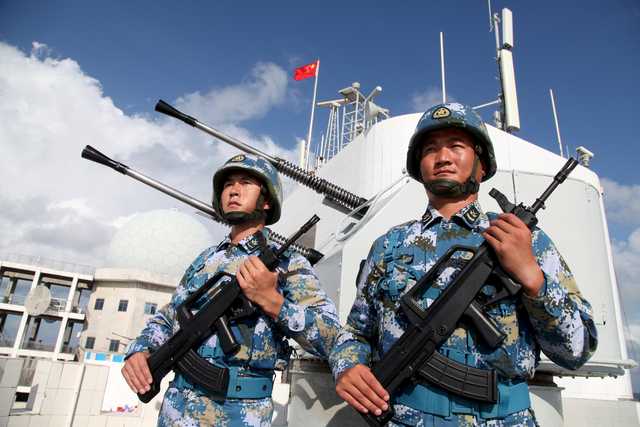
Stung by the ruling of an international tribunal rejecting its claims over the South China Sea, China has upped the stakes, with its defence minister warning of a possible “people’s war at sea” and exhorting the nation to be prepared for it.
China’s Defence Minister Chang Wanquan has asked the military, police and general population to be ready to defend the country’s territorial integrity in case of a direct confrontation in the South China Sea – a veiled reference to the US military build-up around the disputed islands.
The minister’s comments indicate China’s hardening position and the growing tide of nationalism over the South China Sea issue in the aftermath of the ruling by the Hague tribunal rejecting its historic claims over the disputed maritime region. The comments are seen as a message to the US, which has been sending warships and military planes close to the South China Sea islands as a possible hedge against China’s military assertion. Beijing has slammed the US’ provocative behaviour in the wake of the tribunal’s ruling.

The build-up towards the 8th BRICS summit India will be hosting in Goa in October has acquired a momentum, with a series of meetings being planned in the next ten …
Read More
Introduction It is more than two weeks since the abortive coup on the night of 15-16 July took place in Turkey. Although additional information has become available, it is still …
Read More
In an unprecedented crisis, around 10,000 Indian workers, most of whom worked with Saudi construction companies, are stranded in Saudi Arabia without food and money, with the Indian government working overtime to alleviate their suffering. Minister of State for External Affairs Gen (retd) V.K. Singh is set to leave for Jeddah tonight (August 2) to make an on-the-spot assessment of the situation.
The pitiable plight of hungry and penniless Indian workers in Saudi Arabia has come as a shock to the Modi government, which has made diaspora outreach and welfare a key plank of its foreign policy. The food crisis afflicting Indian workers in Saudi Arabia has erupted barely four months after Prime Minister Narendra Modi visited Saudi Arabia and was assured by the top Saudi leadership about the welfare of the Indian community, including migrant workers, in the Arab world’s largest economy. Mr Modi interacted with the Indian workers as well as the well-heeled Indian community in two separate outreach events in Riyadh. Saudi Arabia is home to around 3 million Indians, the largest expatriate population in the Gulf powerhouse.