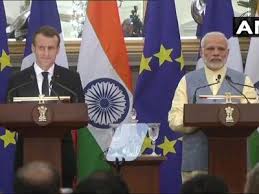
France should be the best partner for India : Macron
“France should be the best partner for India, especially in Europe, the entry point for Europe ” French President Macron,who arrived on a four-day visit to India
Read More
Global Indian News
“France should be the best partner for India, especially in Europe, the entry point for Europe ” French President Macron,who arrived on a four-day visit to India
Read More
Even minutes after the United Nations Security Council pushed Syrian regime’s backer Russia to agree to a ceasefire, the bombardment of eastern Ghouta, a suburb of Damascus, still continued.According to a UK based monitor called Syrian Observatory for Human Rights, the regime has killed over 500 people in less than a week. The regime calls it a lie, but the locals from Ghouta say Assad has been raining lethal barrel bombs, among other ammunition, on 350,000-400,000 remaining inhabitants of Ghouta, shoving them underground.
The regime first imposed a siege in the area, ringing the capital in May 2013. Albeit at prices ten times higher than in Damascus, basic materials like food and fuel were supplied through the al-Wafideen opening. Rebels also dug tunnels leading to Damascus to smuggle in the goods. Since late last year, the siege has been absolute. Syrian forces bombed the tunnels and sealed Wafideen.

The Left’s last citadel in India has crumbled, with the Bharatiya Janata Party set to replace the 20-year old rule of CPI(M)’s Manik Sarkar in an election that has proved to be quite revolutionary. The BJP is leading in 40 seats, crossing the 2/3rd mark after counting began this morning for the 59 assembly seats, giving a decisive push to its Mission Northeast.
From securing around 1.5 per cent votes in the last assembly election in 2013, to this historic election verdict, it has been an impressive performance of the BJP that aligned with the Indigenous People’s Front of Tripura. The party carried out an aggressive campaign in the state with Prime Minister Narendra Modi and party heavyweights like Amit Shah, Rajnath Singh, Yogi Adityanath leading the campaign.

Imparting a new energy to New Delhi’s Look West policy, India and Jordan have taken their security cooperation to a new level by signing a defence framework agreement and inked a clutch of agreements in diverse areas.As countries that face the common threat of terrorism and extremism, India and Jordan have also decided to bolster their cooperation in counter-terrorism and deradicalization.
The talks between Prime Minister Narendra Modi and Jordanian King Abdullah II in New Delhi on March 1 have deepened strategic dimension of the burgeoning India-Jordan ties. The major takeaway was the signing of a defence framework agreement that covers areas like training, defence industry, counter-terrorism, military studies, cyber security, military medical services and peace-keeping.

In a move that could help bridge India’s infrastructural gap, the Asian Infrastructure and Investment Bank (AIIB) has approved $1.5 billion in loans to India for a host of infrastructure-based projects in 2018. While the loan will be utilized for the development of energy, roads and urban centres, there will be a special focus will be on enhancing India’s renewable energy capacity.
With 7.74 per cent equity share in the multilateral development bank, India is only second to China which holds 29.9 per cent. Operating from 2016, the 84-member bank, which was initiated by China, is focussed on supporting infrastructural development across the Asia-Pacific region.

Amid raging conflicts in the Gulf region, India and the Hashemite kingdom of Jordan are set to transform and upgrade their strategic and economic ties during the visit of Jordan’s King Abdullah II to New Delhi.
The King’s itinerary in India includes a visit to IIT Delhi, attending a CEO roundtable, participating in the India Jordan-Business Forum and addressing a conference on Islamic heritage and moderation.
The highlight of the visit will be the unveiling of a new framework for enhanced security and defence partnership.

The rise and rise of China’s President Xi Jinping is set to acquire a new momentum and reality as the Communist Party of China gears up to extend the presidential service beyond the two consecutive terms. This move to scrap two-term limit means that Xi Jinping could choose to rule the world’s second largest economy for his entire lifetime.
Mr Xinping has emerged as the most powerful leader of China since Mao Zedong and Den Xiaoping as was evident in his elevation to the CPC pantheon in the 19th Party Congress in November last year.
The abolition of the two-term limit on the tenure of the president means that China is staring at an indefinite leadership by Mr Jinping beyond 2023 when his second term ends. Getting such a proposal approved in the parliament that opens on March 5 is no difficult task since it is filled with Party loyalists. The 64-year-old Chinese leader secured a second five year term as the General Secretary of the CPC last year and this too may last well beyond the usual 10 year term.
India and Canada have signed six pacts and decided to fast-track negotiations for two defining agreements to expand their economic relationship. It was a clear signal that although Canadian Prime Minister Justin Trudeau’s indulgence of Sikh separatists will remain a thorny issue, but for now the two sides have not allowed it to hijack their relationship.
On the last leg of his week-long tour that has been hotly debated, Mr Trudeau met his Indian counterpart Narendra Modi in New Delhi on February 23 and discussed a wide range of bilateral and global issues. After the talks, the two sides signed six agreements in the fields of energy, sports, higher education, intellectual property rights and cooperation in science, technology, innovation and electronics.

The less-than-warm welcome extended to Canadian Prime Minister Justin Trudeau, who is on a week-long visit to India, has already raised speculations about New Delhi cold-shouldering the Canadian leader over the Khalistani separatist issue.
Observers noted that there was no official tweet from either Prime Minister Modi or External Affairs Minister Sushma Swaraj welcoming Mr Trudeau to India and neither did Mr Modi accompany the Canadian leader on his visit to Gujarat. The Indian government’s displeasure with Canada’s support to pro-Khalistani activities in recent years is well known. Ahead of the visit to India, two of Trudeau’s cabinet ministers accompanying him had clarified that they did not sympathise with the demand of a separate Khalistan.
With an eye on expanding India-Canada business partnership, Canadian Prime Minister Justin Trudeau will be meeting top business leaders today in Mumbai, the third city that he is visiting after Agra and Ahmedabad. Apart from participating in a women business leaders’ roundtable discussion and a film industry event, he is also scheduled to meet with Maharashtra Chief Minister Devendra Fadnavis.

Dismissal of Hinduism is not needed for preservation of India’s secular values, but it has to be disentangled with the vision of the ‘Hindutva Brigade’ that has no place for other faiths, say veteran Congressman Dr Karan Singh and senior party leader Dr Shashi Tharoor.They expressed their view of Hinduism at a lively discussion on the book ‘Why I am a Hindu’ written by Mr Tharoor, a also a well-known author and a former UN diplomat.
The two scholars also cautioned against the Hindutva Brigade’s attempt to equate Hinduism with nationalism.Mr Tharoor targeted Prime Minister Narendra Modi and other leaders of his part BJP for trying to appropriate Swami Vivekanada on wrong grounds, Dr Tharoor said.
Read More