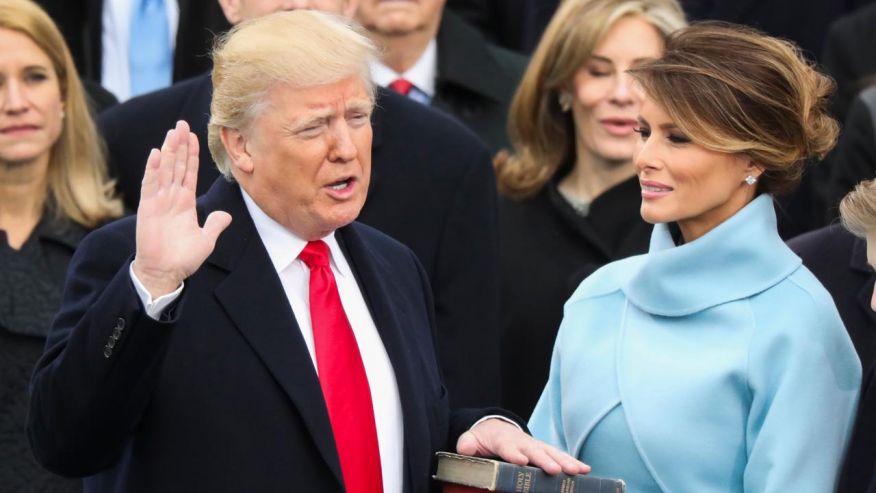
Trump sings America First anthem

With the stirring anthem of “Making America Great Again” and the mantra of America First to empower the country’s “forgotten men and women,” Donald J. Trump was sworn in as 45th president of the US at Capitol in Washington D.C on Friday noon (January 20). It was vintage Trump in many ways as he enunciated his core message of focusing on America’s economic resurgence and staying away from distractions of internationalism. “From this day forward, a new vision will vision will govern our land. It’s going to be only, America,” said Mr Trump in his typical straight talk. The message coming out from the inauguration speech was unambiguous: under Trump’s watch, the US will be more focused on the domestic agenda, with the overarching objective of restoring prosperity to millions of Americans who, as he has consistently argued, have ended as losers of globalisation. There was hardly any utterance on the America’s leadership in the world, except a terse statement about reinforcing old alliances and forming new ones. Mr Trump’s clarion call for uniting the civilized world against Radical Islamic Terrorism and his promise that the US under his watch “will eradicate completely from the face of the Earth,” will be closely dissected in capitals of the world, and signal a muscular national security posture, which could entangle the US in a new global war on terror.

Read More

Vietnam wants India to play a more active role in Southeast Asia: Envoy

It’s a milestone year in India-Vietnam relations as the two strategic partners celebrate the 45th anniversary of the establishment of diplomatic relations. In this wide-ranging interview with Manish Chand, Editor-in-Chief, India Writes Network, Vietnam’s ambassador to India Ton Sinh Thanh outlines a vibrant picture of the trajectory of this crucial relationship and underlines the need for a more active role by India in Southeast Asia and the extended region. The envoy also underscored that the burgeoning India-Vietnam relations is not targeted at China or any third country and stressed on peaceful resolution of the South China Sea dispute through dialogue.

Read More

Pakistan must shun terror if it wants peace with India: Modi

nveiling a big-picture vision of India’s foreign policy and its organic linkage with the ongoing transformation of the country, Prime Minister Narendra Modi has underlined his dream of “a thriving well-connected and integrated neighbourhood,” but singled out Pakistan’s use of terror as an obstacle in fructifying this quest.

In an all-encompassing speech on the emergence of “multi-polarity with multilateralism,” as the new normal in the evolving international geopolitical landscape, Mr Modi reminded Pakistan “to walk away from terror if it wants to walk towards dialogue with India.”

“A thriving well-connected and integrated neighbourhood is my dream,” said Mr Modi at the inaugural session of the second edition of Raisina Dialogue, a signature foreign policy conference organised by Ministry of External Affairs, in collaboration with Observer Research Foundation.

“My vision for our neighbourhood puts a premium on peaceful and harmonious ties with entire South Asia. That vision had led me to invite leaders of all SAARC nations, including Pakistan, for my swearing in,” he said. “For this vision, I had also travelled to Lahore. But, India alone cannot walk the path of peace,” he said. “It also has to be Pakistan’s journey to make. Pakistan must walk away from terror if it wants to walk towards dialogue with India.”

Mr Modi’s expose of Pakistan in front of an audience, which also comprised ministers and experts from over 60 countries, was an extension of his diplomatic campaign to isolate Pakistan in the aftermath of the terror attacks in Uri and Pathankot last year.

Mr Modi, however, struck a more nuanced position on India’s relations with China, which remain conflicted and marred by differences over a host of issues, including Beijing’s continuing opposition to India’s membership of the Nuclear Suppliers Group.

Read More
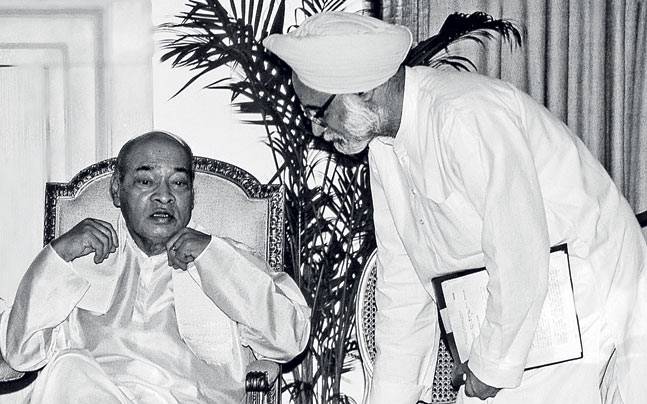
Manmohan Singh was accidental finance minister, Narasimha Rao led 1991 reforms and foreign policy reset: Sanjaya Baru

Who was the architect of India’s path-breaking economic reforms of 1991? No prize for guessing it? Think again, it’s time to get it right! In this wide-ranging conversation with Manish Chand, Editor-in-Chief of India Writes Network, Dr Baru, a former media advisor to Prime Minister Manmohan Singh and a veteran journalist, speaks about defining events of 1991, the pivotal year in not just India’s economic journey, but also in the country’s politics and foreign policy, and the crucial role of Narasimha Rao in shaping outcomes conducive to India’s national interests. In the realm of foreign policy, Dr Baru outlines defining steps taken by Narasimha Rao in response to emerging global power shifts, including the launch of Look East policy, resetting relations with the US and China and the outreach to Israel. Commenting on the ongoing political churn in India, the author says that Prime Minister Narendra Modi’s 2004 election victory has brought a quarter century of accidental prime ministers in the country to an end, but he needs a second term to leave a lasting legacy. Excerpts from the interview) – Read more….

Read More