Trump-Abe bonding and bonhomie: US-Japan alliance to grow stronger

Talks at the White House, dinner at a private club and a round of golf — US President Donald Trump and Japanese Prime Minister Shinzo Abe showed how serious diplomacy and weekend fun could blend to strike a personal chemistry between them and herald a new chapter in ties between the world’s sole super power and its major ally in Asia.
Appearing at a joint media conference with Mr Abe after the talks, Mr Trump underlined the US’ commitment to defend Japan in the face of China’s massive maritime build-up and North Korea nuclear missile programme. This categorical assistance appears to have put behind Mr Trump’s strident election campaign rhetoric last year that suggested Tokyo pay more for enjoying the American security umbrella.
“We are committed to the security of Japan and all areas under its administrative control and to further strengthening our very crucial alliance,” the US president said. “The bond between our two nations and the friendship between our two peoples runs very, very deep. This administration is committed to bringing those ties even closer,” he added.
Mr Abe’s Washington mission proved to be successful as he got Mr Trump’s assurance in clear terms that the US would continue to back Japan in its dispute with China over territorial claims in some islands in the East China Sea that China also claims. The joint statement said the two leaders affirmed that Article 5 of the US-Japan security treaty covered the islands, known as the Senkaku in Japan and the Diaoyu in China, as is evident from Mr Trump’s reference to the areas under Japan’s administrative control.
The Trump-Abe meeting was closely scanned in Beijing, which sees the US-Japan alliance as posing a formidable obstacle to its regional ambitions in the Asia-Pacific region.

Read More

Mattis-Parrikar talk: US assures India of sustaining momentum in defence ties

Amid anxiety in India over the Trump administration’s H1B visa policy, there is a reassuring note from Washington about sustaining the momentum in burgeoning defence relations between India and the US. Days after US President Donald Trump called Prime Minister Narendra Modi, Defence Secretary James Mattis spoke to his Indian counterpart Manohar Parrikar and underscored the new administration’s commitment to build upon the transformation in India-US defence relations accomplished in the last few years.
In the first conversation between the two defence ministers since the change of guard in Washington, Secretary Mattis committed to build upon the tremendous progress in bilateral defense cooperation made in recent years, underscoring the strategic importance of the US—India relationship and India’s role in advancing global peace and security,” Pentagon Press Secretary Capt Jeff Davis said in Washington DC on February 8.
On the strategic and security side, the signalling from the Trump administration has been largely positive. In his telephonic conversation with Prime Minister Narendra Modi, Trump had assured that the US “considers India a true friend and partner in addressing challenges around the world.” The two leaders also decided to bolster the partnership between the United States and India in broad areas such as the economy and defense.

Read More
Goa Brics India 2016

Goa summit and beyond: Charting the future of BRICS

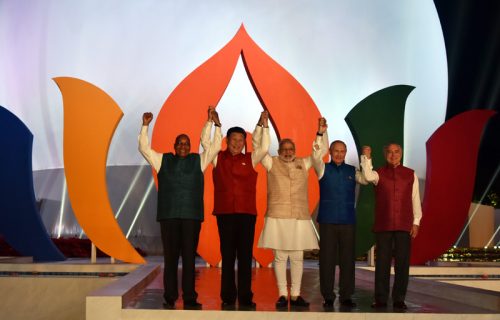
India’s presidency of the BRICS grouping of emerging powers has come to an end after a packed year of more than a hundred events, meetings, and conventions. The highlight was the meeting of the Heads of States organised in Goa on 15-16 October where all the leaders of BRICS countries were in attendance.
International developments in the past couple of years have squarely put the spotlight on the constituent countries of the BRICS forum. Russia’s expanding role in Syria, China’s One belt One Road initiative, which will have massive economic and political implications for Eurasia, South and South East Asia and Africa, and the centrality of India’s and China’s emission pathways to the success of the international climate agreement have accorded these countries a central role in some of the major global challenges of our times.
But the BRICS forum itself has faced questions of continuity for some time now, and the considerable slowing down of their economies, increasing antagonism and strategic clashes between China and India, as well as the pre-eminence of the growing Russia-China partnership have further reinforced these doubts.
Seen in this context, the BRICS governments’ push to further institutionalise and consolidate their progress is an indication of the importance they still attach to the forum, and a decade since coming together, they seem poised to expand beyond being an economic grouping demanding a seat at the high table to substantial cooperation in other sectors.Within last year, BRICS countries greatly diversified their cooperation through working groups on counter terrorism, employment, environment, agriculture, health, economy and trade, education and vocational training, anti-corruption, infrastructure, information and communication technologies (ICTs), and energy.

Read More

Budget Session: President focuses on financial inclusion, empowerment of poor

India’s President Pranab Mukherjee kicked off the Budget session with his speech to a joint session of both houses of the parliament, in which he underscored the BJP-led NDA government’s vision of inclusive economy and governance by highlighting a slew of schemes directed at empowering the poor, the underprivileged and women. Mr Mukherjee described the move to merge the Railway and Union Budgets this year as “historic.”

Read More

Dr Kalam proved President can be agent of change: S.M. Khan

Think of Dr A.P. J. Abdul Kalam, and many laudatory adjectives come readily to mind. Scientist extraordinaire, the father of India’s space and missile programme, nation-builder, dreamer, an inspirational speaker who loved igniting young minds, with his own life serving as a model of self-fashioning and achieving despite formidable odds.
A new book by S.M. Khan, who served as press secretary to President Kalam, makes his portrait more vivid and compelling. nterspersed with anecdotes and personal conversations the author had with the president, “The People’s President” unpacks Dr Kalam’s pioneering role in raising the bar for the presidency under India’s parliament system of government and providing it the much-needed people’s touch.
In this wide-ranging conversation with Manish Chand, Editor-in-Chief, India Writes Network, Khan, currently Director-General of the Registrar of Newspapers for India and a former spokesperson for Central Bureau of Investigation, speaks insightfully about the making of the people’s president and how Dr Kalam remapped the contours of the presidency by positioning people at the centre of his outreach and dispensing with most of ceremonial aspects associated with this exalted institution. Most important, as the author says, Dr Kalam tried to prove in those five years that the President, while remaining within the framework of the Constitution of India, can be an agent of change and transformation and contribute to the nation’s development in a tangible way.
Excerpts from the interview….

Read More