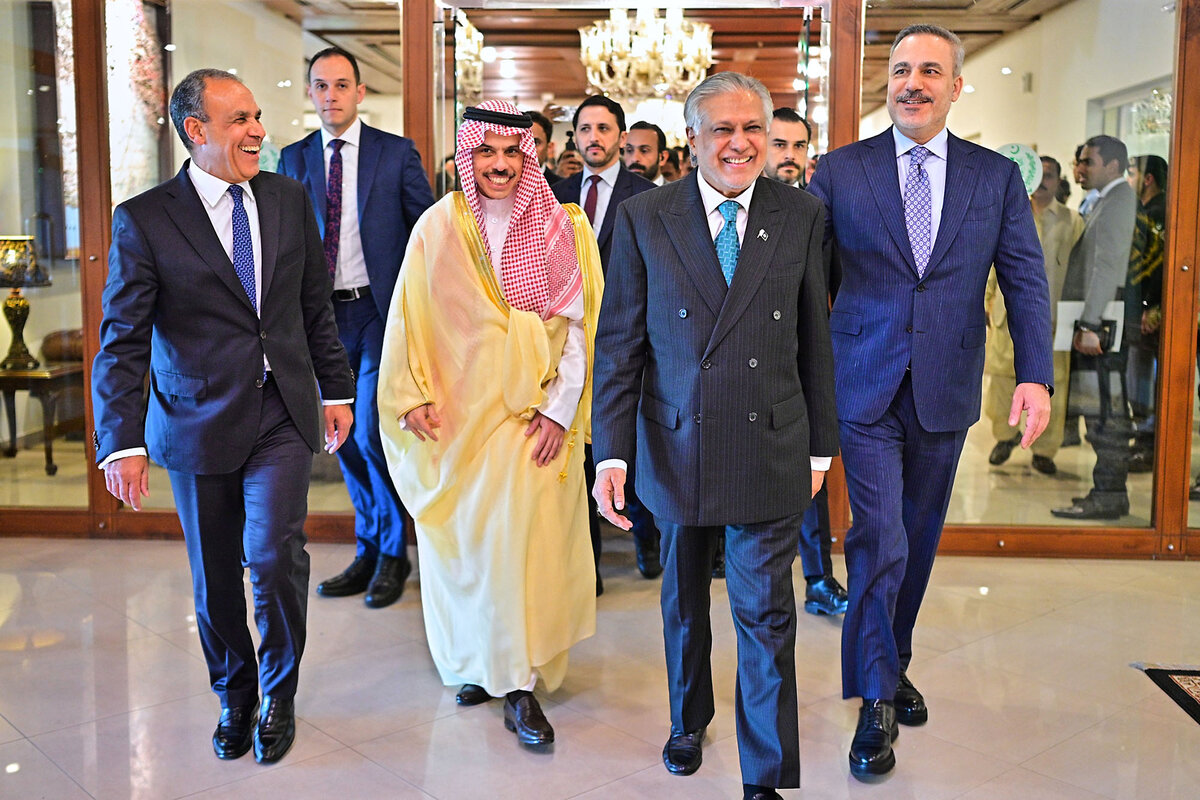
The ongoing US–Iran conflict has taken an unexpected diplomatic turn, with Pakistan emerging as a mediator between the two warring sides. This has raised questions given Pakistan’s regional positioning, its ties with Gulf countries, and its own internal and external security challenges.
In this edition of “Decoding Diplomacy,” Manish Chand, CEO, Centre for Global India Insights (www.cgiiglobal.org) and India Writes Network (www.indiawrites.org), speaks with defence and foreign affairs expert Capt. Alok Bansal, Executive Vice President of India Foundation, about the rationale behind Pakistan’s role, the implications for India, and geopolitical calculations shaping the conflict.
(Excerpts from the interview)
Q: What is the idea behind the US and Iran agreeing to have Pakistan as a mediator?
A: We need to understand that as far as President Trump is concerned, he is very happy and comfortable with anybody who is willing to kowtow to him. Pakistan’s army chief, Field Marshal Asim Munir, has actually taken a fancy to him and has done what he wants. Trump has, on numerous occasions, talked about his favourite Field Marshal and his Prime Minister. So, it is the Field Marshal who is playing the ball.
From the US’ point of view, Pakistan is doing everything that is feasible within its bidding. In addition, Pakistan already has a defence deal with Saudi Arabia under which it is supposed to provide military assistance in case of a war or conflict. With this conflict going on, Pakistan is under pressure because any attack on Saudi Arabia goes against this collective defence arrangement. And Iran is a neighbour of Pakistan.
Asim Munir has also tried to curb pro-Iran sentiments within Pakistan. After the initial flare-up, he went to the extent of telling Shia clerics that they could leave Pakistan and go to Iran if they felt so strongly.
At this point, he has the ear of not only the United States but also Saudi Arabia, which brings other Gulf countries into the picture. Pakistan has reasonably good relations with most Gulf countries.
Of late, Pakistan has also been reaching out to Israel, though under public pressure it has not spoken about it openly. Ever since the conflict started, Pakistan’s public posture has been pro-Iran — criticising the US and Israel — while balancing its position in other areas.
In this conflict, Pakistan has played both sides. Other mediators like Iraq and Turkey had direct stakes in the conflict, and Oman, after initial attempts, was also affected by Iranian retaliatory strikes. Under these circumstances, Pakistan was seen as a suitable pick.
Pakistan’s policymakers have always toyed with a larger-than-life role. If you remember the 1970s, Yahya Khan, when Bangladesh was burning, was trying to build bridges between the United States and China. He thought his name would be enshrined in history, but what happened in his backyard overshadowed everything. So that has been the pattern.
Q: You mentioned Pakistan’s relations with Gulf countries and its balancing act. But India also has strong relations across sides. What are the implications for India, and why is India not stepping into such a role?
A: Firstly, India is a democracy, and the government has to pander to the public opinion. It cannot be oblivious to it. In Pakistan, there is hardly any democracy, so decisions can be taken irrespective of public opinion. That flexibility does not exist in India.
Secondly, in recent years, the Indian foreign policy establishment has been extremely conservative. We have been reluctant to take proactive steps and have largely been reactive. There is a tendency to err on the side of caution rather than take risks.
Q: India’s External Affairs Minister has called Pakistan a “broker” and said India is not in the business of ‘dalali’. What is the message behind that?
A: The message is significant. Pakistan’s proximity to the US is not necessarily based on national interests alone. It is probably linked to the personal business interests of certain sections of the Trump family and certain elites in Pakistan.
It is the elites in the two countries that have brought them together. Pakistan is doing the bidding of certain powerful individuals within the United States. That is why the term “dalal” or broker has been used — because Pakistan is seen as acting to facilitate certain interests.
Q: There is also an irony here — Pakistan has tensions with Afghanistan and a history of sponsoring terrorism, yet is seen as a mediator. How do you view this?
A: There is no doubt that Pakistan is at war with Afghanistan, even if there is a temporary ceasefire. By carrying out strikes inside Afghanistan, Pakistan has effectively sanctified the idea that a country can strike inside another country if it believes attacks are originating from there.
This has broader implications. It creates a precedent that can be used by other countries as well.
Q: Coming to the peace plan conveyed via Pakistan, which Iran has rejected — how do you assess its viability?
A: As of now, Iran’s power structure appears fragmented. We are not very sure about the exact state of its leadership. There are reports that different centres of power, including the IRGC, are operating with significant autonomy.
The elected government under President Pezeshkian is relatively reformist, especially in foreign policy terms. If the conflict had stopped earlier, it might have allowed him to consolidate his position. But the continuation of the war has led to a rallying effect and strong anger against the US and Israel.
Iran has put forward a six-point proposal, which reflects a maximalist position — asking for reparations, control over Hormuz, removal of US bases, and so on. These are starting positions.
On the US side, there appears to be a lack of clarity. There are divisions within the administration. Some individuals with future political ambitions would not want to be associated with the ongoing offensive, especially given changing public opinion.
At the same time, there are hawkish sections and other interests pushing for continuation. Israel, from its perspective, benefits from a weakened or fractured Iran.
So, there are conflicting interests. Peace is possible, but at this moment it looks difficult.
Q: Given that both sides continue to strike each other, what should India do to help bring the war to an end?
A: At this stage, Pakistan is attempting to play that role, so we should see how that evolves. If Pakistan fails, India could take an initiative — possibly in collaboration with a country like Oman.
Given the personalities involved and the national positions, a third party is required. Neither side would want to be seen as conceding directly, so mediation becomes necessary.
Author Profile

- Manish Chand is Founder and Editor-in-Chief of India Writes Network (www.indiawrites.org) and India and World, a pioneering magazine focused on international affairs. He is CEO, Centre for Global India Insights, an India-based think tank focused on global affairs.
Latest entries
 India and the WorldSeptember 13, 2026BRICS transcends Gulf divide, pitch for UN fast-tracking reforms
- DiplomacySeptember 13, 2026BRICS bonding bolsters India-Vietnam ties
- India and the WorldSeptember 11, 2026Decoding India’s BRICS moment: Forging an Inclusive World
- In ConversationSeptember 9, 2026India’s BRICS Chairship Critical for Global South: South Africa’s Envoy