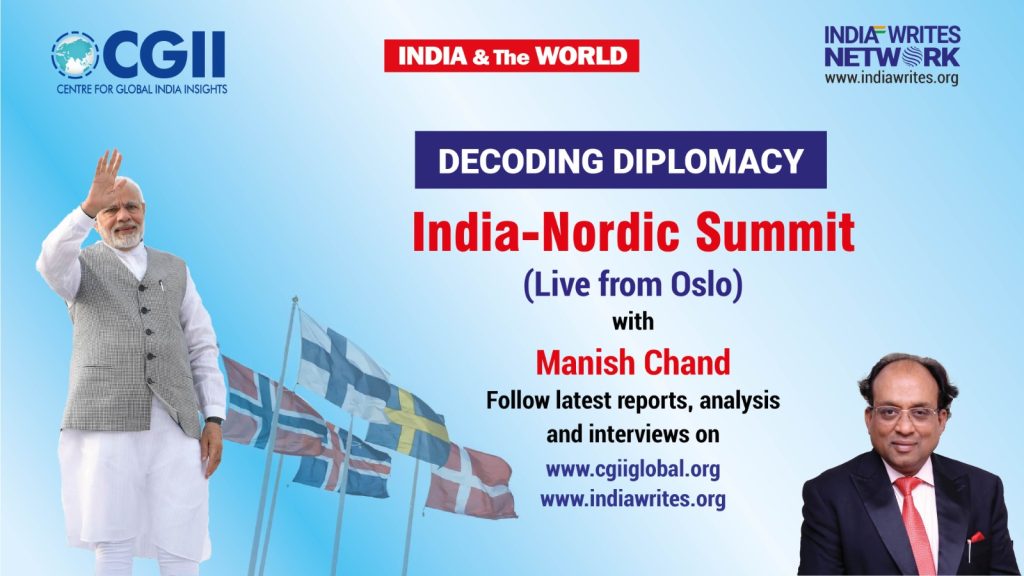
OSLO: In the “land of the midnight sun,” a new dawn in India-Nordic relations will radiate light on pathways of this multifarious partnership that will circle around green technologies, trade, digitalisation and innovation.
Breaking a hiatus of more than four decades, India’s Prime Minister Narendra Modi will descend on the Norwegian capital to galvanise the centuries-old “sambandh” (connection) in Hindi and samband in Norwegian, between India and Norway and the larger Norwegian region. The last Indian prime minister to visit Norway was Mrs Indira Gandhi in 1983, and since then a lot of ice has melted to set the stage for 2.0 version of India-Nordic partnership.
Oslo is rolling out the red carpet for the Indian leader, who has taken time out from geopolitical convulsions of the last two months, to deepen development-focused partnership with Nordic countries. PM Modi will hold full-spectrum talks with his Norwegian counterpart Jonas Gahr Støre and jointly meet Indian and Norwegian business representatives at the Norway-India Business and Research Summit.
Ahead of the visit, the Norwegian prime minister has struck an upbeat note saying he looks look forward to welcoming Prime Minister (PM) Narendra Modi and underlined that it “marks a moment when countries with complementary strengths choose to move closer together.”
Scaling a New Summit
Then showpiece of PM Modi’s visit to Oslo will be the third India-Nordic summit on May 19. The summit will bring together the leaders of India and the Nordic countries Denmark, Finland, Iceland, Sweden and Norway.
For India, the summit offers an opportunity to institutionalise partnerships with some of the world’s most advanced innovation economies. For the Nordic countries, India represents scale, market depth, strategic relevance and a democratic partner in an uncertain global order.
Unlike earlier India-Europe engagements that revolved mainly around trade and development cooperation, the India–Nordic format has evolved into a future-oriented strategic platform. The agenda is expected to include green energy, climate technology, digitalisation, maritime cooperation, Arctic governance, innovation ecosystems, blue economy partnerships and resilient supply chains.
The summit is also taking place in the broader context of the recently concluded India–EU Free Trade Agreement, which has accelerated India’s strategic engagement with Europe. The Nordic region, known for high technology and sustainability leadership, can become India’s gateway to advanced European industrial partnerships.
‘The summit is important for strengthening cooperation on green transition, digitalisation, innovation and trade. It provides closer political dialogue and opportunities for increased economic cooperation between the regions,’ said Norway’s PM Støre.
Expanding partnership in renewable energy, a forte of Nordic countries, will dominate the summit discussions. Norway, one of Europe’s largest energy exporters, is expected to discuss a long-term LPG supply arrangement with India.
The future-oriented dimension will go beyond hydrocarbons and focus more on green energy. The Nordic states are global leaders in offshore wind, carbon capture, hydrogen technologies, electric mobility, battery innovation, and circular economies. India is pursuing one of the world’s largest clean energy transitions under its net-zero and green industrial ambitions. This creates the basis for a strategic partnership in what may become the defining economic sector of the twenty-first century, green industrialisation.
Transformative Strategic Alliance
“The summit would provide an opportunity to shape and develop an ambitious agenda of cooperation in the areas of trade and investment, innovation, clean and green tech, blue economy, and cutting-edge,” said Sibi George, Secretary (West), in India’s Ministry of External Affairs.
“It will also impart a more strategic dimension to our relationship with the Nordics in tech and innovation,” he said.
Placing the significance of the India-Nordic relations in the larger global context, Dr Shashi Tharoor, MP and author, writes: “The Oslo Summit is the moment to transform this historical sambandh into a transformative strategic alliance for the 21st century.”
“At a time when the turbulence of the Trumpian era has unsettled global norms, India and the Nordic countries share a common interest in defending world order and stability. Making common cause with them would not only diversify India’s diplomatic portfolio but also strengthen our voice in shaping a multipolar system that values fairness, cooperation, and rules‑based governance,” Tharoor writes memorably.
“The opportunity is clear: To transform a relationship free of major conflicts into one of purposeful collaboration.”
(Manish Chand is CEO, Centre for Global India Insights, a think tank focused on global affairs, and Editor-in-Chief, India Writes Network. He is in Oslo to report and analyse PM Modi’s visit to Norway)
Author Profile

- Manish Chand is Founder and Editor-in-Chief of India Writes Network (www.indiawrites.org) and India and World, a pioneering magazine focused on international affairs. He is CEO, Centre for Global India Insights, an India-based think tank focused on global affairs.
Latest entries
 India and the WorldSeptember 13, 2026BRICS transcends Gulf divide, pitch for UN fast-tracking reforms
- DiplomacySeptember 13, 2026BRICS bonding bolsters India-Vietnam ties
- India and the WorldSeptember 11, 2026Decoding India’s BRICS moment: Forging an Inclusive World
- In ConversationSeptember 9, 2026India’s BRICS Chairship Critical for Global South: South Africa’s Envoy