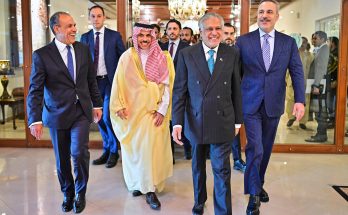
As India and Japan seek to deepen their Special Strategic and Global Partnership amid a rapidly changing geopolitical landscape, Japanese Prime Minister Sanae Takaichi’s July 1–3 226 visit to India marks an important milestone in bilateral engagement. In this conversation, Manish Chand, CEO, Centre for Global India Insights, speaks to Amb (Retd. Sanjay Kumar Verma, a former Ambassador of India to Japan, about the strategic significance of the visit, economic cooperation, defence ties, the Indo-Pacific, Quad, Northeast connectivity, and the future trajectory of India-Japan relations.
(Excerpts from the interview)1
Q: This is Japanese Prime Minister Sanae Takaichi’s first visit to India. How do you see the significance of this visit? We already have a very robust architecture of engagement with Japan. What more can we expect this time around?
A: Every visit has its own architecture and structure to go along with it, and this visit will not be any different. When she is here the entire relationship will be reviewed, gaps identified, new directions issued, and new political dimensions introduced in light of the changing global geopolitical environment.
I would look at this visit as another significant milestone in trust-building between our two countries. If you look at the way the two countries have developed their collaboration and bilateral relationship, in 2000 we instituted the Annual Summit and called it a Global Partnership. In 2006, as trust deepened, it became a Strategic and Global Partnership. In 2014, when Prime Minister Modi visited Japan, the relationship was upgraded to Special Strategic and Global Partnership. If you look at how the bilateral relationship has evolved in its nomenclature, it tells you that trust between the two countries has steadily improved.
Any expectations will emerge from two aspects. One is the bilateral relationship itself, and the other is the prevailing global geopolitical environment. We are looking at four areas: strategic stability, economic resilience, technological cooperation, and regional coordination.
Q: Japan has become India’s pre-eminent economic and development partner. Japanese Prime Minister is in India with a large delegation of corporate honchos and industry leaders. Last year, when Prime Minister Modi visited Japan for the annual summit, the ambition was already raised. Japan pledged to invest something around US$68 billion in India. Can we expect more Japanese investment in India’s growth story?
A: Absolutely. Absolutely.
So let me take you back a little bit.
When you look at the 2025 Summit between India and Japan, when Prime Minister Modi travelled to Tokyo, at that time a very consequential document was agreed between the two leaders, which is known as the Joint Vision for the Next Decade.
It has eight verticals. I call them the eight folds of Buddhism. Buddhism is the quintessential cultural aspect that brings the two countries together.
Economic partnership is the first one. Economic security is the second one. Mobility of talent, which is also somehow related to economic cooperation. Ecological sustainability. When we say ecological sustainability, we are talking about clean energy. So again, economics comes into play. Technology and innovation. Entire economics. Health. Here, health is both practices and products. People-to-people exchanges, tourism. State-to-prefecture relationships, sub-national relationships.
If you look at those eight parts, the eight folds, the eight verticals which were agreed between the two leaders, all of them talk about economics. So economy is the important pivot between the two countries, other than security cooperation, which is very much there. Now let me try to decode this economic cooperation. Till now, we have seen what you termed developmental cooperation. A lot of Japanese public finance has come into the Indian infrastructure sector and into the social development sectors.
Going forward, what we are looking at are the new emerging sectors. The first one is semiconductors. In semiconductors, we have already seen results coming up. ROHM of Japan has already signed two joint venture agreements. You have Tokyo Electron, which has signed an agreement with Tata Electronics. These two have already moved ahead.
Japanese companies generally don’t announce anything unless they have reached a concrete decision. Many of the Japanese semiconductor companies have been visiting both Guwahati and Dholera to look at the ecosystem they would need to set up semiconductor manufacturing.
The second important sector is clean energy. If you look at clean energy, it opens up the entire ecosystem, whether it is solar, wind, hydrogen, ammonia, storage technologies, carbon sequestration, or carbon capture. Above that, a new layer which was defined during last year’s visit was the joint trading mechanism. Carbon trading is also very much part of the picture.
The third very important sector would be telecommunications. This is important not only from the economic security point of view, but also from the economics point of view. Then pharmaceuticals, both products and services.
Critical minerals are not only a national security issue, they are also a major economic vertical. What I see is that slowly we will see economic cooperation converging with the economic security of the two nations.
When these two things happen, dependence on each other through trusted partnerships becomes much more evident, much more fruitful and probably much more successful.
Q: China has been very resentful of the growing India-Japan relationship, for predictable reasons. Japan has also been very vocal in critiquing Chinese assertive postures in the South China Sea and the East China Sea. There is also speculation about an imminent Chinese attack on Taiwan, which is a sort of red line for Japan. How can India and Japan enhance their coordination to constrain Chinese aggressiveness, if I can put it that way?
A: I would not like to say “constrain” any country. Rather, I would say advocate the right path. At the moment, if you look at the kind of coercion and the hegemonic tendencies, these are not good for regional stability and regional peace. If you look at the violations of freedom of sea lanes, freedom of navigation and maritime security, all these are not good signs for global trade.
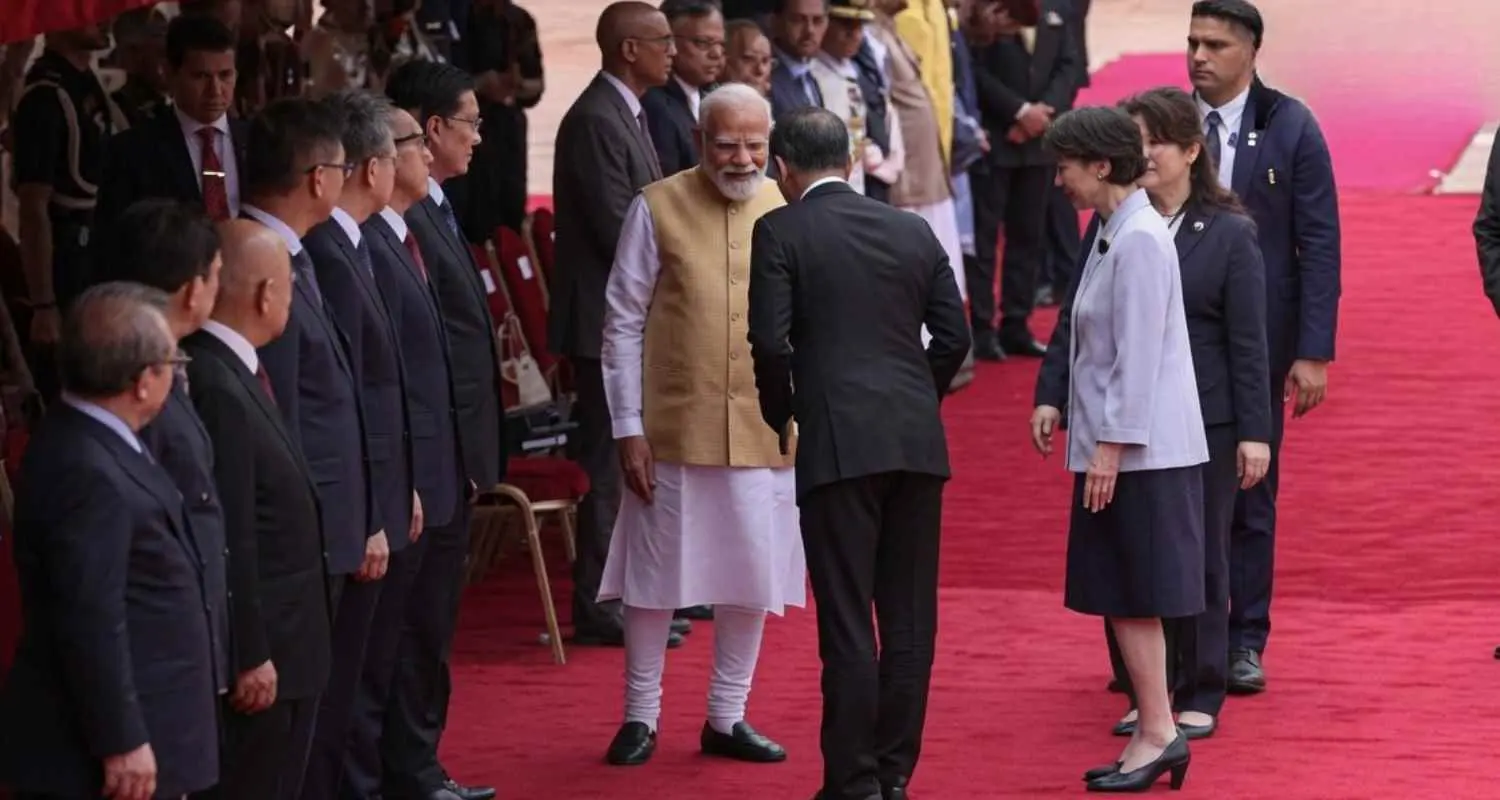
China is the world’s pre-eminent trading country. So, it is not even in the interest of Chinese exports, Chinese imports or Chinese trade. I think there is a need for more dialogue and more diplomacy. Any country that is seen as digressing from, or violating, the rules-based order should be encouraged to come back into the fold and try to become prosperous together with all the countries moving forward.
Q) Ahead of the Japanese Prime Minister’s visit, Japan’s Finance Minister said the India-Japan relationship could become the most important relationship in the world. With India-US relations facing some strains, the India-US partnership was once described as the defining partnership of the 21st century. Do you see the India-Japan partnership becoming the defining partnership of the 21st century?
A: India believes in a multi-aligned foreign policy. We are not aligned with only one country. We are aligned with many countries at the same time. All these alignments are defining moments for us.
Even if we talk about our relationship with Russia, it is a defining relationship. Our relationship with South Korea, Japan, the United States and Canada. If you look at any of these relationships, every relationship has its own balance and every relationship has its own ballast. When they move together, they create defining moments.
No single relationship will be able to take care of the entire requirements of any country. Therefore, you have to depend on many relationships to meet all your domestic requirements and all your international commitments.
So yes, Japan is certainly a relationship that will be defining for India’s future.
Author Profile

- Manish Chand is Founder and Editor-in-Chief of India Writes Network (www.indiawrites.org) and India and World, a pioneering magazine focused on international affairs. He is CEO, Centre for Global India Insights, an India-based think tank focused on global affairs.
Latest entries
 In ConversationJuly 2, 2026Japan PM Takaichi’s visit to India is about economic security
- India and the WorldJune 15, 2026Modi-Macron duo power India-France ties on wings of tech, innovation
- In ConversationJune 14, 2026Myanmar’s President’s visit to India has taken relations to higher level: Rajiv Bhatia
- India and the WorldJune 14, 2026Indian Ocean at Strategic Crossroads