Paradiplomacy: Can India learn from Macau and China?

Owing to the growing engagements that India has with countries around the world, a discussion on the importance of paradiplomacy forms not just a quintessential part of the country’s foreign policy analysis but also makes space for a subsequent and crucial shift in India’s strategies in conducting international relations. As opposed to conventional diplomatic relations, which fall under the exclusive domain of sovereign nation states exercised by central governments, paradiplomacy, a ‘neologism’ makes space for ‘external relations’ of sub-national or federal units which might indulge themselves in international activism in order to promote their own interests. While, broadly, the aims of subnational diplomatic interactions have been to outsource business on account of good governance and to attract investments at a regional level, the advantages of paradiplomacy are many when one speaks of the Indian turf.

Though not Prime Minister Modi’s brainchild in terms of its inception, the concept of ‘constituent diplomacy’ certainly appeals and gains importance in the context of India, which has a highly centralised foreign policy. Never less than incisive in his choice of actions, PM Modi articulated and espoused a greater role for states in boosting India’s economic growth even before assuming office at the Centre. Having competently tested and executed his vision of such decentralisation in Gujarat even within the constraints of the Indian foreign policy scene, Modi indicated a paradigm shift in India’s foreign policy making by appreciating the consequential role that States can and will play in the conduct of diplomacy.

Read More

BRICS & BIMSTEC summits: What it means for India’s counter-terrorism diplomacy

Indian diplomacy experienced an inflection point following the terrorist attack on September 18, 2016, at the Army encampment at Uri. Determined to raise costs for Pakistan to counter its strategy of bleeding India by a thousand cuts, the Indian government mounted an international campaign to paint Pakistan as a state-sponsor of global terrorism and to ‘isolate’ the country in the international community.
India made Pakistan’s state-sponsorship of terrorism, without naming it, a key element of its diplomatic agenda for the 8th BRICS summit hosted by it in Goa on October 15-16; the event also coincided with India-Russia and India-Brazil summit meetings. To deny Pakistan the chokehold on regional integration as well as to further ‘isolate’ it in the region, a BRICS’ outreach with the BIMSTEC at the summit level was organised. In all his interactions, Prime Minister Modi made a clear linkage between terrorism and economic prosperity, underlining Pakistan’s official complicity which casts a dark shadow on countries as well as on multilateral efforts to promote socio-economic progress. In his press statement, at the end of the annual India-Russia summit between PM Modi and Russian President Vladimir Putin, he said Russia’s “clear stand on the need to combat terrorism mirrors our own.”
Prime Minister’s remarks on terrorism, at the concluding session of BRICS summit, were aimed at Pakistan when he declared that combating terrorism, “including cross-border terrorism and its supporters”, will be a key BRICS priority. The Goa Declaration, issued by the summit leaders, contains the key elements of India’s counterterrorism narrative but is less direct on the issue of isolation.
The BIMSTEC Outcome Document is even more satisfactory in terms of India’s counter-terrorism diplomacy.
Aiming to impose costs on Pakistan for pursuing its ‘low cost’ strategy, Indian diplomacy has widened the diplomatic and military space, in its bilateral relations with Pakistan, to ratchet up the pressure especially as focused military action to Pakistani terrorist provocations has not been ruled out. Against the backdrop of incandescent international anger against terrorism, Pakistan cannot misread the signals originating from Goa.

Read More

After Modi-Xi meeting, India-China joint exercise in Ladakh focus on trust-building

In a confidence-building exercise held only days after the meeting between India’s Prime Minister Narendra Modi and China’s President Xi Jinping, India and China have carried out the second edition of the joint military exercise in the Ladakh region of Jammu and Kashmir.

The exercise, held on October 18, was held under the provisions of the Border Defence Cooperation Agreement signed by the two Asian giants in 2013. This was the follow-up of the first drill that took place in February this year on the Chinese side. The exercise, entitled “Sino India Cooperation 2016,” was part of the “Hand in Hand” joint drills to enhance peace and tranquillity along the Line of Actual Control (LAC).

Read More

Suu Kyi visit: India, Myanmar to scale up energy, counter-terror cooperation

Signalling a fresh ballast to New Delhi’s Act policy, India and Myanmar, Southeast Asia’s emerging powerhouse, have decided to scale up their economic and strategic relations to a new level as the two countries signed three pacts in areas of power, banking and training. In a boost to New Delhi’s campaign to isolate Pakistan, Myanmar rallied in support of India and shared the assessment that “the fight against terrorism should target terrorists, hold to account terror organisations, networks and also states that encourage, support or finance terrorism in any way.”
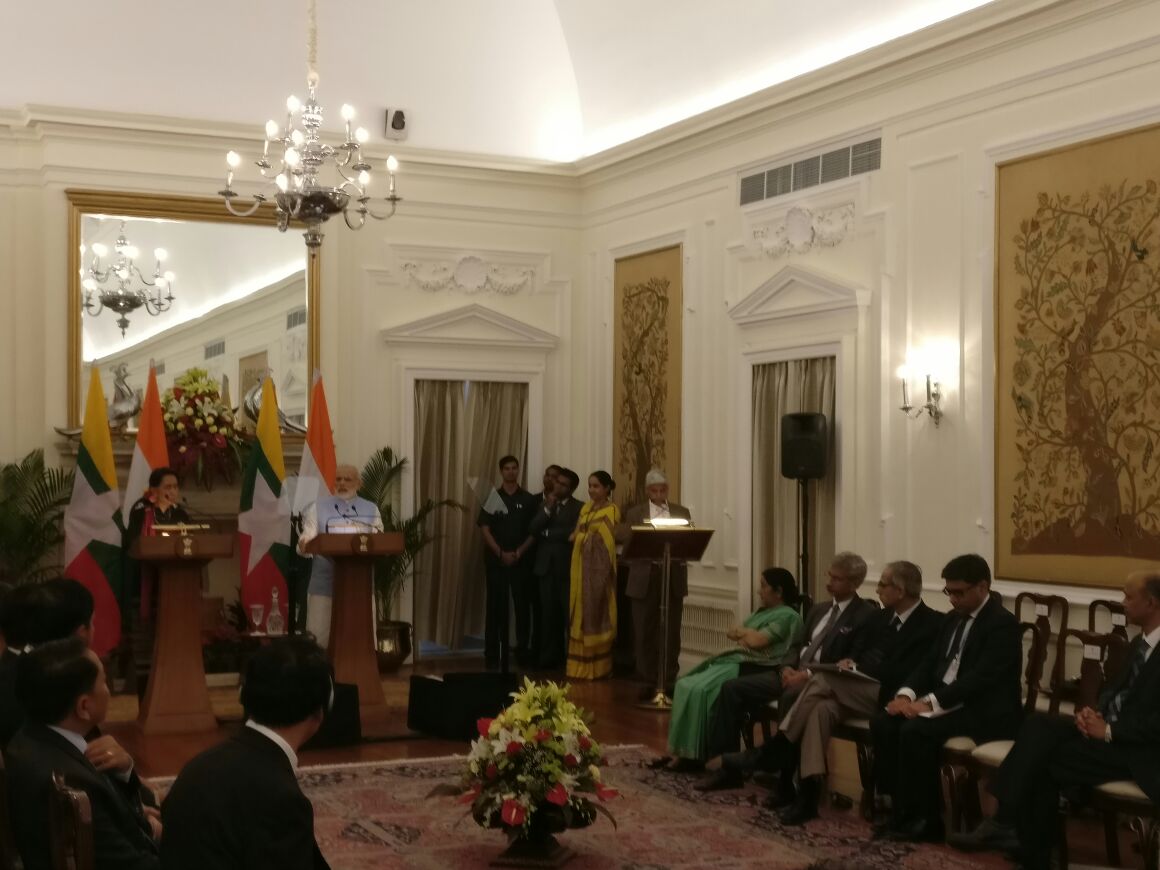
India’s Prime Minster, Narendra Modi and Myanmar’s State Counsellor Aung San Suu Kyi had wide range talks in New Delhi on October 19, three days after they met at the BIMSTEC Summit in Goa. Mr Modi was all praise for dynamism and leadership of the India-educated Suu Kyi, who is spearheading the transformation of Myanmar since the NDL came to power last year. Mr Modi conveyed India’s full support and solidarity in the emergence of Myanmar as a modern, secure, “economically “better-connected nation”.
The talks saw a striking convergence of perspective on terrorism as they discussed plans to intensify security and counter-terror cooperation. The joint statement underscored that the fight against terrorism should target terrorists, hold to account terror organisations, networks and also states that encourage, support or finance terrorism in any way. The two sides “reaffirmed their shared commitment to fight insurgent activity and the scourge of terrorism in all its forms and manifestations,” said the joint statement. “Both sides expressed the view that the long-standing commitment not to allow insurgent groups to use their soil for hostile activities against the other side is essential for the prosperity of the people residing along the border.”
Maintaining security along the 1, 640-kilometre India-Myanmar border remains a challenge. Stressing that the security interests of India and Myanmar are closely aligned, Mr Modi focused on “a close coordination to ensure security in the areas along our border, and sensitivity to each other’s strategic interests.”

Read More

Terrorism narrative at BRICS: India warns of high costs for Pakistan

Amid the growing perception about the lack of consensus at the BRICS summit on New Delhi’s concerns over the Pakistan-origin terrorism, India’s External Affairs Minister Sushma Swaraj has renewed the focus on state-sponsored terrorism and underlined that terrorism “featured strongly in the summit’s narrative and its eventual outcome.” The minister also argued for taking steps to make it costly for those who sponsor and support terrorism.
“While our economic engagement and political cooperation remained key factors, there was a sharp realization that global development and prosperity was very much dependent on continued peace and security. Terrorism was universally recognized as a key threat to stability, progress and development,” Ms Swaraj said at the BRICS Media Forum held in New Delhi on October 18. The forum brought together leading journalists and opinion-makers from India, Brazil, Russia, China and South Africa.
Alluding to the quality of discussions at the October 15-16 BRICS summit in Goa, Ms Swaraj underlined that “there is a developing consensus that it cannot be business as usual.” “We must be prepared to extract costs for those who sponsor and support terrorists, who provide them sanctuary, and who, despite their own claimed victimhood, continue to make the false distinction between good and bad terrorists,” said the minister.
In a damning critique of Pakistan’s pursuit of cross-border terror and obstructionist attitude, the minister said: “There cannot be a greater contrast with those who reject even trade and connectivity for political reasons.” Reaching to such forums that exclude terror sponsoring countries is necessary to shape mechanisms to fight terrorism, she stressed.

Read More

Implications of a Complete Sealing of the India-Pakistan Border

Home Minister Rajnath Singh has recently declared that the entire India-Pakistan border is to be completely sealed by December 2018. The announcement may be viewed in the context of India-Pakistan relations reaching a particular low and uncertain threshold post the Uri incident and cross-Line of Control (LoC) operations by India on 28-29 September 2016. The above-referred decision of the Union Government is reported to have been taken after a review of gaps in border management by a high-level Committee on Security and Border Protection (CSBP) of the Union Ministry of Home Affairs (MHA) (popularly known as the Madhukar Gupta Committee) set up in March 2016 to overcome the lacunae observed consequent on the Gurdaspur and Pathankot infiltration occurrences. The outcome of the review is likely to have influenced the decision on setting 2018 as the target for a total sealing of the border. As of now, Pakistan Government sources have indicated that they have no comments on this development given the absence of details. Some Chinese think-tank commentators have, however, observed that such a venture would be irrational, indicative of Cold War mentality and likely to complicate relations among China, India and Pakistan, without elucidating as to how this decision would impinge on Chinese interests.

Government sources have indicated that a border security grid with a provision for real-time monitoring of the entire length of the border and capability for intervention as necessary is to be put in place. This will obviously involve networked coordination among the states’ home departments and their police authorities, their Central counterparts, MHA and the agencies responsible for technical and electronic surveillance. Furthermore, the works authorities at the central and state levels will have to be involved in the logistics of the forces assigned to protect the border, border fencing, sensors being installed, and providing access road network to the border outposts. It is, however, not clear whether a physical infrastructure in the form of a wall or obstacles on the pattern of the Israeli West Bank defences (in Israeli-occupied Palestine territory) is to be eventually erected.

Read More

BRICS sees rekindling of India-Russia romance

Though India made it a point to focus on terrorism and managed to underscore “the need for close coordination on tracking sources of terrorist financing and target the hardware of terrorism, including weapons’ supplies, ammunition, equipment and training,” it could not convince China to change its stance on Masood Azhar, leader of the Pakistan-based militant group Jaish-e-Mohammed.

The group has been blamed for attacks on Indian soil in the past, including the 2001 parliament attack in Delhi that took the nuclear-armed rivals to the brink of war.

Read More

Sheikh Hasina’s visit to India: What to expect

India’s relations with Bangladesh will get a major boost with the visit of Prime Minister Sheikh Hasina to Goa. Sheikh Hasina is visiting India to attend a summit of the BIMSTEC (Bay of Bengal Initiative for Multi-Sectoral Technical and Economic Cooperation) on the sidelines of the BRICS (Brazil, Russia, India, China and South Africa) summit to be held in Goa on October 15-16. Prime Minister Narendra Modi and Sheikh Hasina are expected to hold a bilateral meeting on the sidelines of the dual summits in Goa on October 16.
Sheikh Hasina will be participating in the multilateral forum along with 11 other leaders from BIMSTEC and BRICS countries. Members of BIMSTEC include Bangladesh, Bhutan, India, Myanmar, Nepal, Sri Lanka and Thailand.

Read More