Art, culture, and diplomacy often intersect in meaningful ways. India’s Ambassador to Spain, Jayant Khobragade, coalesce these strands together in his artistic work, even as he navigates one of India’s key European partnerships.
In this conversation, Manish Chand, CEO, India Writes Network and Centre for Global India Insights, speaks with Ambassador Khobragade about his latest exhibition Journey with the Divine Flow, the evolution of his artistic practice, and the expanding canvas of India–Spain relations across culture, trade, and strategic engagement.
(Excerpts from the interview)
Q) The latest exhibition of your paintings is themed Journey with the Divine Flow. Could you elaborate on the theme of your paintings?
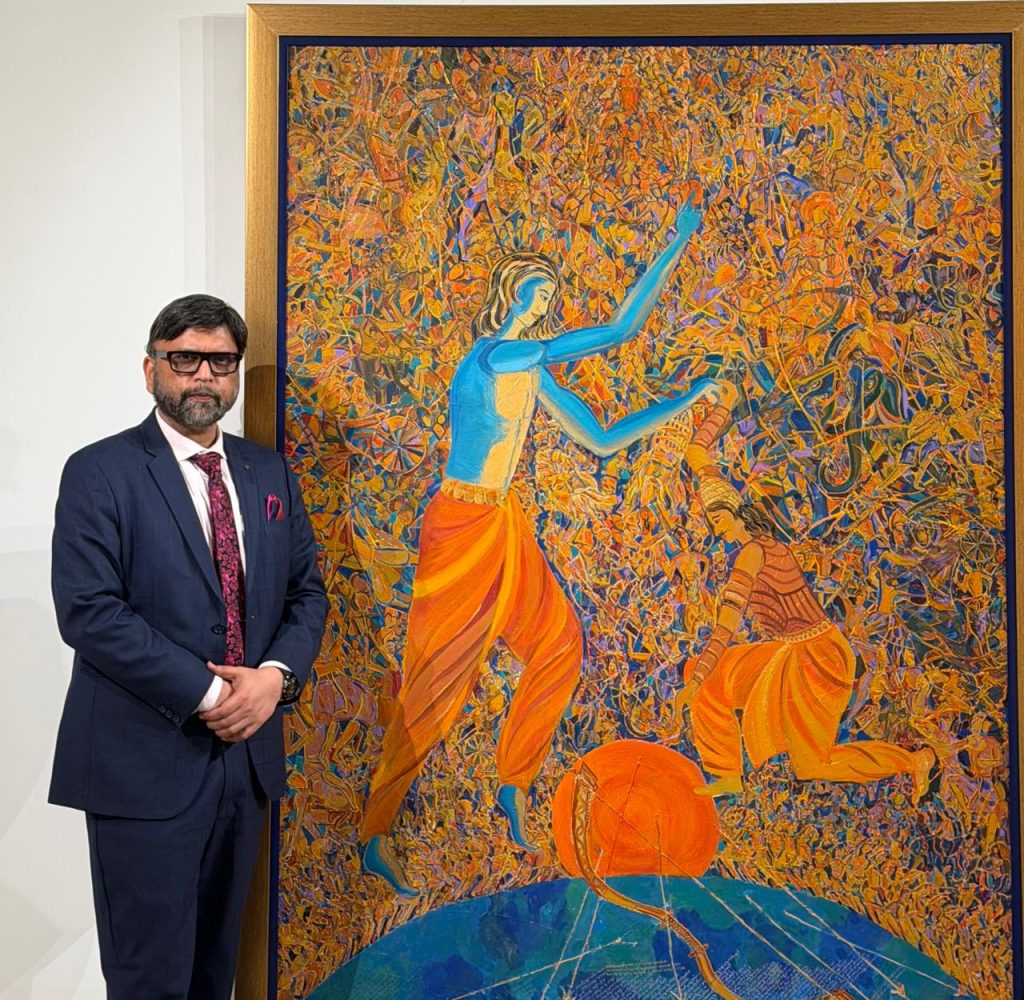
A: I have been painting for the last 35 years, and this is my 15th exhibition. The last time I did an exhibition in Jakarta, the curator observed that my work had three distinct themes — nature, musicians and dancing figures, and civilizational connect. At that time, the title was different. So while I was thinking about what title to give, I came up with this idea of Journey with the Divine Flow.
To use the word “divine” is not easy — it is a big word, and I myself was a bit hesitant. But still I went for it. Because I thought that wherever there is beauty, there is a touch of divinity. And this journey, as explores beauty, I felt that the exhibition could be called Journey with the Divine Flow.
Q: From what I can see, your paintings are thematically divided into three parts — nature, music and dance, and civilizational themes.
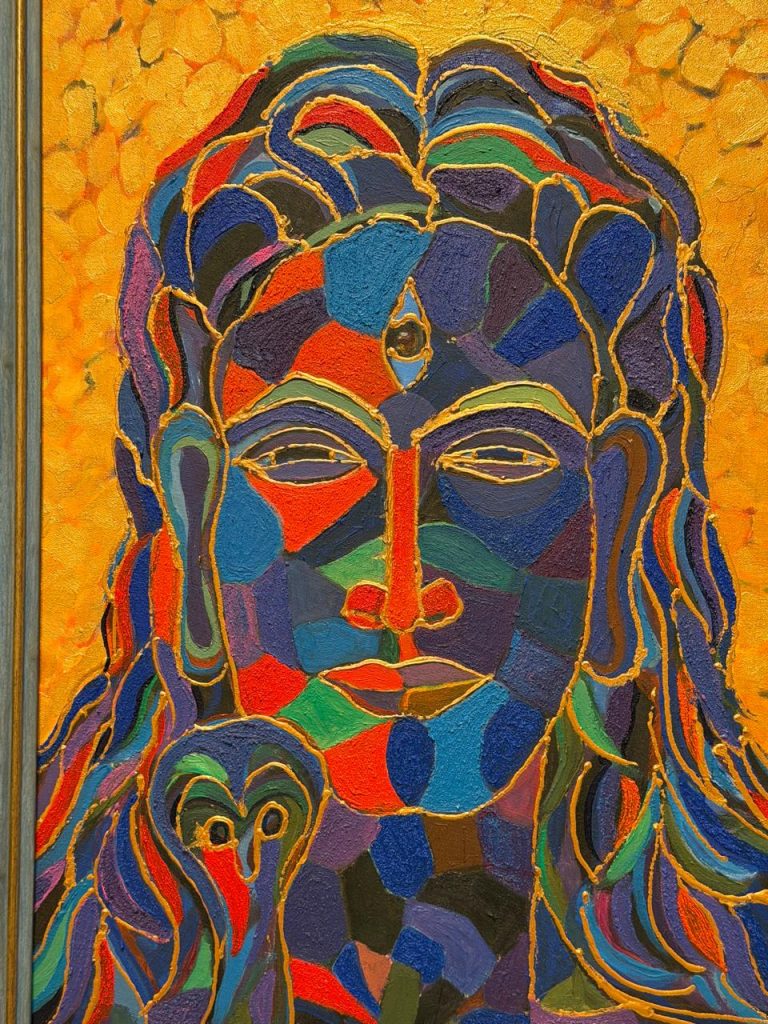
A: Yes. What happens in the process of creation is that your heart gets touched by something external. It could be nature, it could be a musical performance, a dance performance, a poem, or even visiting a temple.
Then that idea stays within you — it acts like a seed — and it starts developing inside. And since I have been painting for so many years, I naturally think in terms of shapes and colours, and you put those ideas on canvas.
Now, these themes are mainly for curation and for understanding. But in practice, I work across all of them. For example, I may do one painting on nature, another on dance, and another on civilizational themes at the same time.
These days, since I am in Spain, that also reflects in my work. I have done a painting on Flamenco. At the same time, I have done a painting on Holi, where Lord Krishna is playing with colours with Radha and the gopis. So, it moves across themes in that way.
Q: If you go back, when did you realise that painting was your true calling? By profession you are a diplomat, but where did this artistic impulse originate?
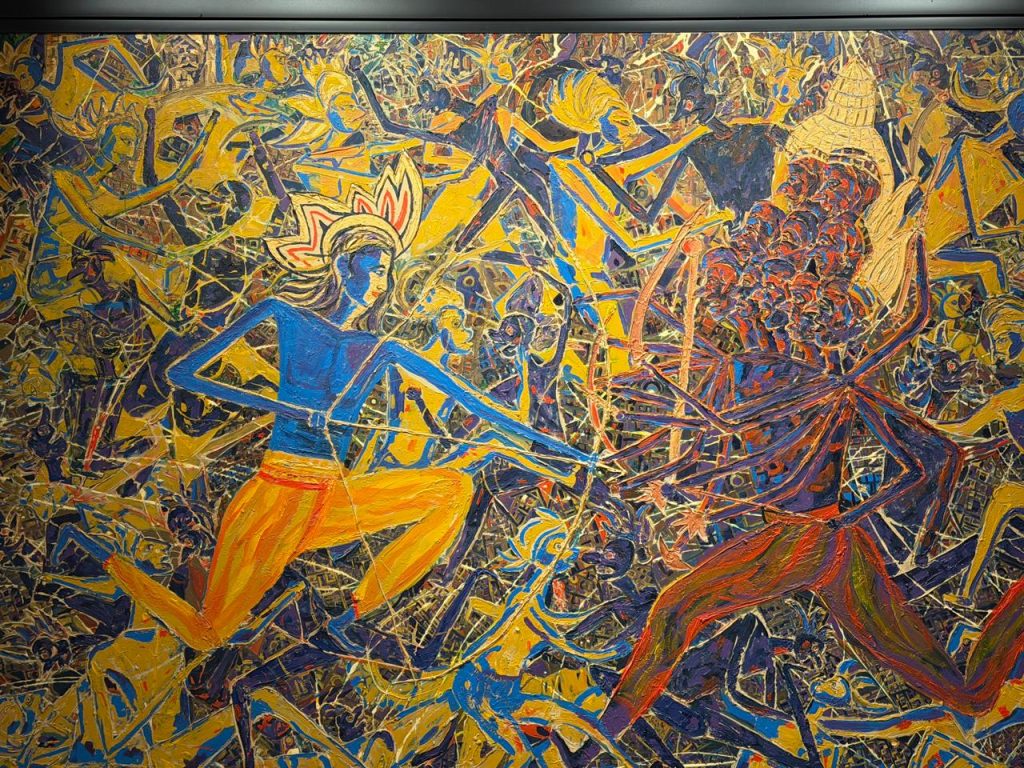
A: In school, I was not bad in terms of sketching and painting. But coming from a middle-class family, the focus was naturally on building a career first. So that remained the priority. But since the mid-1990s, I have been doing painting quite regularly.
Even when I used to listen to Bollywood songs, different images would come to my mind — not necessarily what was shown on the screen. That became a habit.
In fact, when I did an exhibition in 1997 at Lalit Kala Akademi, New Delhi, the theme was based on Mirza Ghalib’s poetry and his ghazals. Over time, expressing myself through forms and colours became a natural way for me.
And when I started getting appreciation, doing exhibitions, that also encouraged me further.
Q: You are posted in Spain, which has a rich tradition of visual arts — from Salvador Dalí to Goya. How has your time in Spain influenced your work?
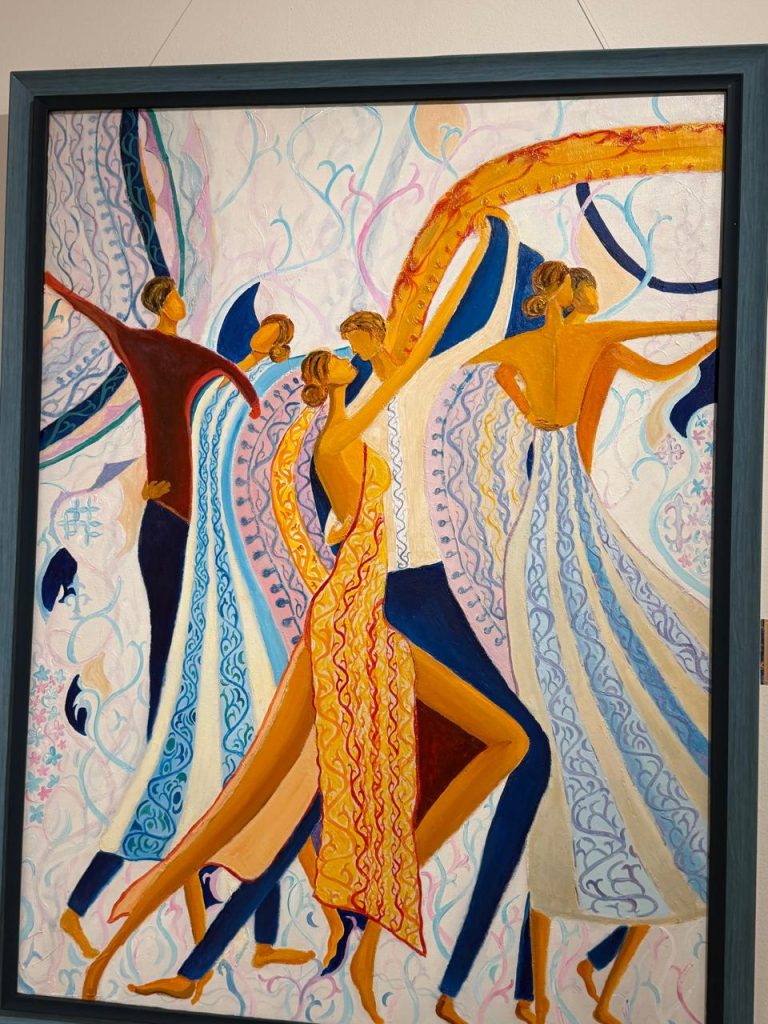
A: Absolutely. This is my second posting in Spain. I had served earlier in the same embassy from 2008 to 2011. At that time, I had the opportunity to visit their museums, which are very rich — both in terms of collection and curation. The landscapes, and also the culture of dance and music, have had an impact.
I am not a trained artist, so I learn from what I see — what I see in museums and what I see around me. As I explained earlier, the process of creation is influenced by what surrounds you. nSo naturally, Spain has influenced me — in terms of my colour palette and also in terms of subjects.
Q: When you talk about formative influences, which artists or traditions have influenced your work?
A: You would be surprised, but my favourite works are in the Ajanta caves. The colour combinations, the storytelling, the narration, and the composition — done nearly 2,000 years ago — are remarkable. It shows how evolved we were at that time.
So, my effort is also to connect with that past. This civilizational connect is both geographic and across time. For example, I have created a triptych on the life of Buddha called Three Moons. Lord Buddha was born, attained enlightenment, and achieved Mahaparinirvana — all on the full moon of Vaisakha.
While depicting the birth, I used a mother figure inspired by the Ajanta caves. I could have drawn any other figure, but I chose that deliberately so that, subconsciously, viewers connect with that tradition.
India-Spain relations
India-Spain Ties on Upswing: Defence industrial corridors on the way
Q) India and Spain are celebrating the 70th anniversary of their diplomatic relations in 2026 by declaring it the “India-Spain Dual Year of Culture, Tourism, and Artificial Intelligence”. How do you assess the current trajectory of this important relationship?
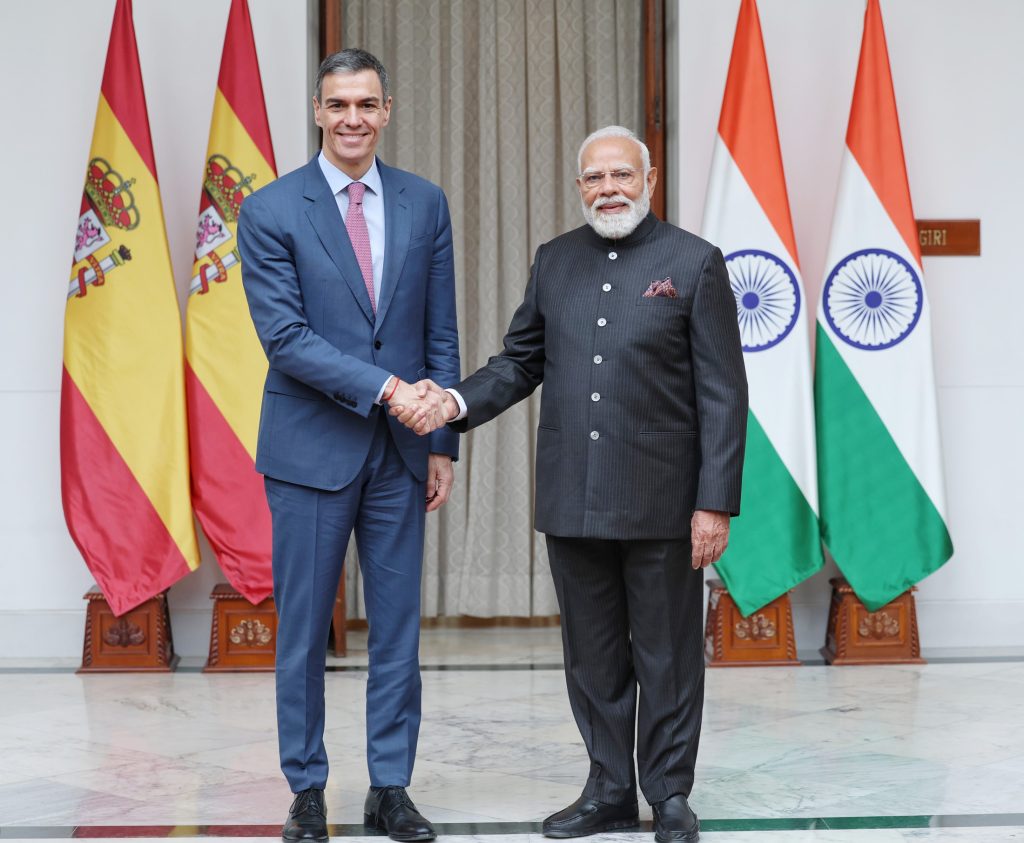
A: The visit of Prime Minister Narendra Modi to Spain in 2017 can be seen as a turning point.
Then, of course, COVID happened. But last year, in January, Hon’ble External Affairs Minister Dr. S. Jaishankar visited Spain and addressed the conference of Spanish ambassadors — the first time a foreign guest had done so. That is still remembered.
Even in the last few months, there has been strong engagement. We have had the visit of the Spanish foreign minister. Spain’s President Pedro Sánchez came for the AI Impact Summit in February 2026, and there were events related to the dual year.
From our side also, there have been visits by ministers of culture, law and justice, and communications. In a sense, the relationship — political understanding, trade, investment — all aspects are progressing quite well.
Q: India–Spain trade is around $10 billion. How can this be stepped up?
A: One important development is the India–EU FTA, which we expect to be signed soon. That will be a game-changer because as tariffs come down, market access improves.
If you look at sectors, textiles is very important. We are already exporting around $1 billion worth of textiles and apparel. Currently, duties are around 4–12%, and when these come down, it will improve competitiveness. Other important areas are automotive components, pharmaceuticals, specialised chemicals, and electronic equipment. These form our main export basket.
Q: Defence is an important area of India-Spain cooperation. What is the progress in this crucial area?
A: Defence has become a very important aspect of the relationship. I visited the facility in Vadodara where we have assembly line of C295 transport aircraft a joint venture between Airbus and Tatas — it is a state-of-the-art “Make in India” project.
But we are not going to stop there. The next step is to promote defence industrial corridors in Uttar Pradesh and Tamil Nadu. I have been in touch with stakeholders, including the Society of Indian Defence Manufacturers.
There has been a strong interest from Spanish companies. We had planned an event in Madrid, which had to be rescheduled, but we are working on it. I am confident that this engagement will lead to concrete outcomes.
The focus remains on Make in India and Atmanirbhar Bharat.
Q: What about specific areas for co-production?
A: At this stage, we have connected Indian stakeholders with Spanish companies. They are exploring possible areas of collaboration.
We are organising sector-specific interactions — in defence and beyond — to identify concrete opportunities.
Q: Spain has shown interest in the Indo-Pacific Oceans Initiative. What is the progress?
A: Spain has officially conveyed its interest in joining IPOI in January this year during the visit of their foreign minister to India. Now we are discussing which of the seven pillars they would like to focus on. These discussions are ongoing.
Q: This is also a year of culture, tourism and AI. What are the key initiatives?
A: On culture, we have institutions like Casa de la India in Valladolid, and we are expanding activities with the support of ICCR.
One major event will be held at the Alhambra in Granada, featuring a performance by a Ravi Shankar dance troupe along with the Granada Philharmonic.
We are also planning exhibitions, film screenings, and workshops.
On tourism, although we do not yet have direct flights, traffic is growing — around 220,000 Indians visited Spain last year, and about 80,000 Spaniards visited India.
We are encouraging airlines on both sides to consider direct connectivity.
Q: How does Spain view India’s rise as a global power?
A: Spain recognises India’s growing global role. There is now greater focus on India in Spain. In the current geopolitical context, diversification is important, and India is seen as a key partner. They recognize India’s strategic autonomy and economic trajectory. My message to them is always — be a part of India’s growth story.
Author Profile

- Manish Chand is Founder and Editor-in-Chief of India Writes Network (www.indiawrites.org) and India and World, a pioneering magazine focused on international affairs. He is CEO, Centre for Global India Insights, an India-based think tank focused on global affairs.
Latest entries
 India and the WorldSeptember 13, 2026BRICS transcends Gulf divide, pitch for UN fast-tracking reforms
- DiplomacySeptember 13, 2026BRICS bonding bolsters India-Vietnam ties
- India and the WorldSeptember 11, 2026Decoding India’s BRICS moment: Forging an Inclusive World
- In ConversationSeptember 9, 2026India’s BRICS Chairship Critical for Global South: South Africa’s Envoy