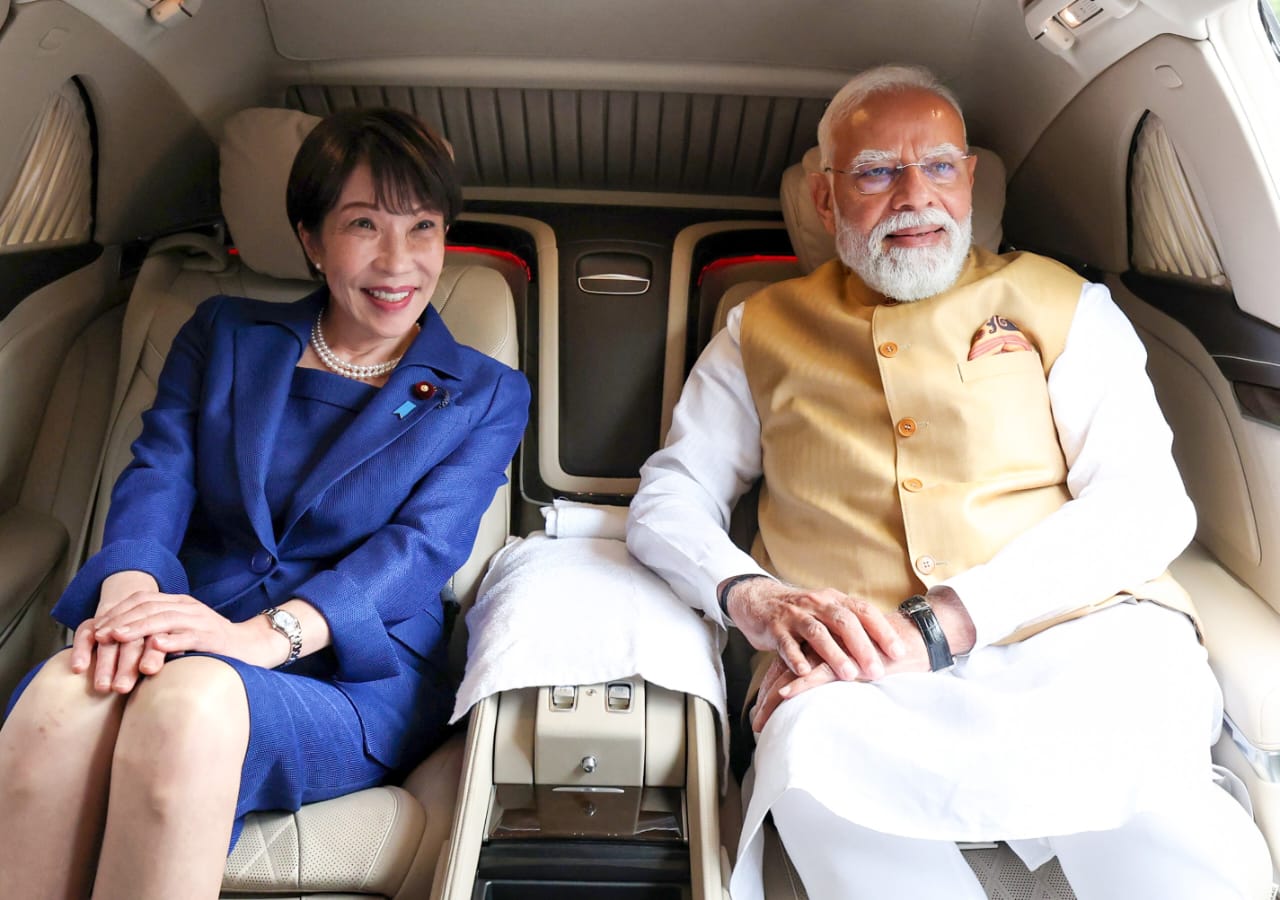
India and Japan must combine their complementary strengths to shape a free, open and multi-polar Indo-Pacific in which no single power can dominate the region. During Japanese Prime Minister Sanae Takaichi’s re-cent visit to New Delhi, India and Japan signalled a shift from parallel national strategies toward a more integrated Indo-Pacific approach, says Amb. (Retd.) Sanjay Kumar Verma.
In the early years of this century, the Indo-Pacific was largely framed by powers beyond the region. Today, as strategic competition deepens, its long-term stability will depend less on external guarantees and more on whether regional states themselves are prepared to preserve a favourable balance of power.
Japanese Prime Minister Sanae Takaichi’s recent visit to New Delhi underscored that shift. More than reaffirming an already strong bilateral relationship, the visit pointed to a broader geopolitical reality: the Indo-Pacific is gradually acquiring an Asian centre of gravity. Regional powers are no longer expected only to preserve the existing order; they are increasingly expected to shape it.
The proposed India-Japan-Philippines track 1.5 consultations are a telling example. They suggest that the strategic conversation is widening beyond familiar summitry and alliance logic and moving toward a more distinctly regional form of agency.
Japan is India’s natural strategic partner in this endeavour. It combines technological leadership, economic strength and policy consistency with a long-standing commitment to a rules-based regional order. Together, India and Japan have the opportunity to move the Indo-Pacific beyond an aspirational idea and toward a durable strategic framework.
India-Japan Summit
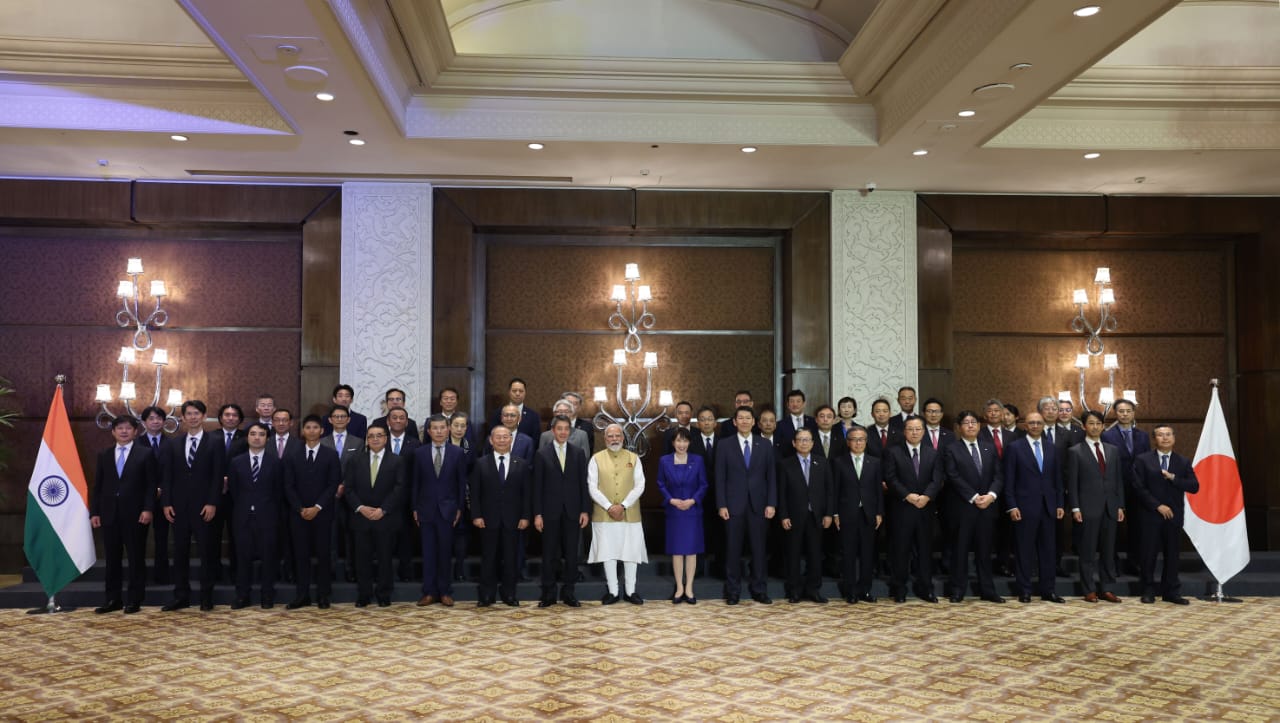
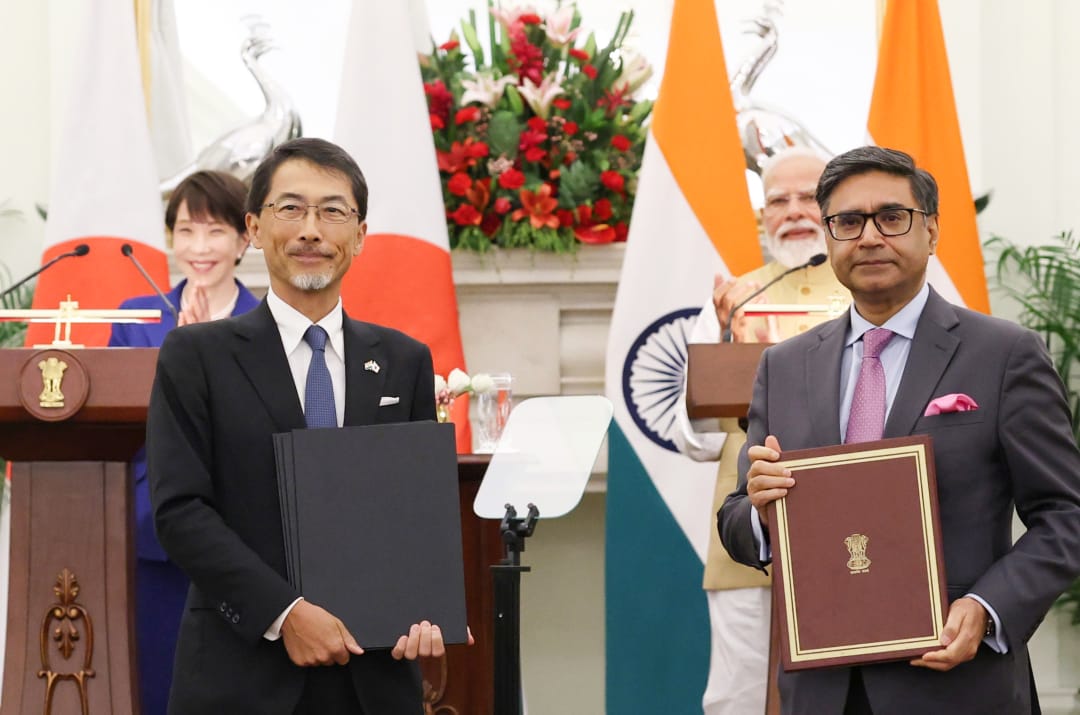
The outcomes of the 16th India-Japan Annual Summit lent concrete substance to that opportunity. The two sides agreed to deepen cooperation in critical technologies, economic security, clean energy, pharmaceuticals and defence co-development, while reaffirming their shared commitment to a rules-based regional order. Strategically, however, the summit’s significance lies less in the list of sectors than in the implicit framing. By treating these domains as interlocking components of regional resilience rather than discrete bilateral projects, New Delhi and Tokyo signalled a shift from parallel national strategies toward a more integrated Indo-Pacific approach.
The joint statement, in effect, read like an early blueprint for co-anchoring: India and Japan are no longer merely aligning their positions on the Indo-Pacific; they are beginning to co-construct the institutional and material foundations that can sustain it.
The strategic landscape has changed profoundly since the Indo-Pacific first entered the diplomatic vocabulary. Competition now extends far beyond military capabilities. Supply chains have become geopolitical assets, while rivalry over semiconductors, critical minerals and advanced technologies has intensified. Economic coercion, cyber vulnerabilities, grey-zone tactics and sustained maritime pressure have become recurring features of regional competition, not isolated exceptions.
In that environment, the familiar principles of a Free and Open Indo-Pacific remain indispensable but no longer sufficient. Freedom of navigation, respect for international law and sovereign equality still define the normative foundation of the regional order. But norms alone cannot guarantee stability. They must be matched by the resilience to withstand sustained political, economic and military pressure.
That is why Japan’s Free and Open Indo-Pacific strategy remains so relevant. When Shinzo Abe first articulated the concept, he reshaped strategic thinking by linking the Indian and Pacific Oceans into a single geopolitical theatre. More importantly, he framed a positive vision centred on openness, the rule of law and sovereign choice rather than confrontation or bloc politics.
Prime Minister Takaichi’s approach appears to build on that foundation rather than replace it. The emphasis has shifted toward resilience, economic security and the reduction of strategic vulnerabilities, while preserving the principles that gave FOIP its broad appeal.
This is less a change of direction than an adaptation to a region where openness can survive only if states have the capacity to resist coercion.
MAHASAGAR & FOIP
India’s own maritime thinking has evolved in a similar direction. The transition from SAGAR to MAHASAGAR — Mutual and Holistic Advancement for Security and Growth Across Regions — signals a broader conception of maritime strategy. Security remains central, but it is now tied more closely to connectivity, resilient supply chains, technological cooperation and sustainable economic development. The aim is no longer simply to safeguard sea lanes; it is to strengthen the wider ecosystem on which regional prosperity and security depend.
The convergence between MAHASAGAR and Japan’s evolving FOIP is therefore more than rhetorical. Shared strategic language often precedes policy convergence. Both frameworks recognize that stability depends not only on military capability, but also on preserving the ability of states to make independent strategic choices. Both seek to strengthen resilience without forcing countries into rigid alignments. In doing so, they offer a vision of the Indo-Pacific that is both open and inclusive.
The challenge now is to turn that convergence into lasting capability. Shared principles matter only when they produce institutions, habits of cooperation and tangible outcomes. India and Japan have reached the point where affirming common values is no longer enough. The partnership must increasingly function as an operational framework for strengthening regional resilience.
The first priority is diplomatic coherence. New Delhi and Tokyo should consistently present FOIP and MAHASAGAR as complementary, not competing, strategic frameworks. Whether in bilateral summits, ASEAN-led forums or wider multilateral institutions, a shared vocabulary reinforces a shared purpose. Over time, diplomatic consistency helps shape expectations about acceptable behaviour and strengthens the norms that underpin the regional order.
Maritime cooperation should remain the partnership’s most visible expression. The Indo-Pacific is, above all, a maritime system whose prosperity depends on secure sea lanes and confidence in international law.
Expanding maritime domain awareness, strengthening logistics agreements, improving information-sharing and deepening interoperability will contribute more to long-term deterrence than periodic political declarations. Durable strategic partnerships are rarely built through dramatic gestures; they are forged through sustained effort over time.
Economic Security
Economic security deserves equal priority. Strategic competition increasingly unfolds through supply chains, technology standards and access to critical resources rather than conventional military confrontation alone. The disruptions witnessed during the pandemic, together with intensifying competition over semiconductors, artificial intelligence and critical minerals, have shown that economic resilience is now inseparable from national security. Cooperation between India and Japan in these sectors should therefore be seen not merely as commercial engagement, but as an investment in the strategic autonomy of the wider Indo-Pacific.
ASEAN Centrality
No vision for the Indo-Pacific can succeed without ASEAN at its centre. ASEAN remains indispensable not because it can resolve every regional dispute, but because it provides the legitimacy and institutional balance on which a durable regional order depends. Its members naturally differ in their strategic priorities and relationships with major powers. That diversity is a source of resilience rather than weakness, provided regional initiatives reinforce ASEAN’s centrality instead of bypassing it.
India and Japan have largely recognised this reality, seeking to strengthen Southeast Asia’s strategic capacity without asking its members to choose between competing camps. The proposed India-Japan-Philippines consultations and similar frameworks with other ASEAN members can become important instruments in preserving the rules-based order in the South China Sea.
Closer coordination among India, Japan and individual Southeast Asian states would strengthen maritime capacity, reinforce respect for international law and demonstrate that regional security is best advanced through inclusive partnerships rather than exclusive blocs.
Mapping the Future
This points to a broader lesson. The future of the Indo-Pacific will not be secured by a single alliance, one dominant power or a rigid bloc structure. It will be sustained by overlapping partnerships that expand strategic choice, strengthen resilience and raise the costs of coercion.
The defining contest in the Indo-Pacific is no longer simply about military superiority. It is about which vision of regional order proves more durable: one built on coercion and dependence, or one founded on sovereign choice, resilience and cooperation.

That is where India and Japan assume wider significance. India brings geography, scale, strategic autonomy and an unusual ability to bridge different political constituencies across the Indo-Pacific. Japan contributes technological leadership, financial strength and decades of strategic consistency. Together, they offer something the region increasingly requires: a partnership that is neither directed toward domination nor constrained by formal alliance structures, but dedicated to preserving strategic balance and expanding the choices available to other states.
The Indo-Pacific has moved beyond being a geographical construct or a diplomatic slogan. It is now the principal arena in which the future balance of power in Asia will be shaped. The question is no longer whether the concept has taken hold; it clearly has. The more consequential question is whether regional powers possess the political will and strategic imagination to sustain it.
Increasingly, the answer will depend on the region itself. External powers will remain important to regional security, but they can no longer be expected to carry the entire burden of maintaining the regional order. That responsibility must increasingly be shared by those with the greatest stake in its preservation.
India and Japan are well placed to lead that effort, not by seeking dominance, but by strengthening the institutions, partnerships and resilience that make dominance by any single power less likely. If the Indo-Pacific is to remain free, open, inclusive and genuinely multipolar, it will be because countries within the region decided to invest in a rules-based order before coercion became its defining principle. In that endeavour, India is an indispensable pivot, and together with Japan, one of the principal architects of the Indo-Pacific’s future.
Author Profile

- Manish Chand is Founder and Editor-in-Chief of India Writes Network (www.indiawrites.org) and India and World, a pioneering magazine focused on international affairs. He is CEO, Centre for Global India Insights, an India-based think tank focused on global affairs.
Latest entries
 India and the WorldOctober 19, 2026India-US trade deal soon, says Rubio
- In ConversationOctober 16, 2026Sanctions create new opportunities, invest in Tatarstan: Taliya Minullina
- Photos / VideosOctober 16, 2026Live from Kazan: India–Tatarstan Connect | Manish Chand in conversation with Taliya Minullina
- India and the WorldSeptember 13, 2026BRICS transcends Gulf divide, pitch for UN fast-tracking reforms