This will be Prime Minister Modi’s second bilateral visit to Indonesia after 2018. It is also his fourth visit to Indonesia because he came for the India-ASEAN Summit in 2023, when I had just joined, then for a brief visit just before the G20 and for the G20 Summit in Bali.
I sincerely hope that this visit will provide a fresh impetus to the relationship because we all, at our respective levels, try to push the envelope and create opportunities for bilateral engagement. It is only high-level visits that give profile and trajectory to a relationship. I think, in that sense, this visit is very, very welcome.
In the current geopolitical situation, with the wars in Ukraine and the Middle East, India and Indonesia talking to each other and developing closer ties carries an inherent message. It is important for think tankers to reflect on that. But I personally feel, as a practitioner, that it has considerable significance. The India-Indonesia relationship has a lot of potential. The work done by my predecessors and many others has built a very strong base for our relationship.
President Prabowo was the Chief Guest at the Republic Day celebrations in 2025, along with the Indonesian marching contingent. His visit was very significant. It left a lasting impression on him and reinforced the need for closer ties. There was a lasting impression on him, and that has had a very salutary effect on India-Indonesia relations.
I recently heard a foreign ambassador say that, under the previous administration, only some countries got all the deals or had access. In the current administration, there are many more players and much greater access for other countries. I think that has been a positive spin-off for India.
Economic ties between India and Indonesia are growing at a steady pace. Bilateral trade is now almost US$30 billion. Two-way investments are growing. It is not only Indian investment in Indonesia. We are now seeing significant Indonesian investment in India.
One of the meetings planned during Prime Minister Modi’s visit is his interaction with selected Indonesian CEOs who do business in India. So, it is a two-way stream and two-way traffic. We are seeing significant interest from Indonesian companies in investing in India. Of course, Indonesia is a strong and very reliable source of raw materials for the Indian economy.
Growing Interdependence
As the Indian economy powers ahead, it will require more raw materials. Indonesia has proved to be a very reliable source. Recently, I was talking to the CEO of Tata Power. He was saying that many of our power plants, particularly those along the coast, are technically suitable only for Indonesian coal. There is a dependency that has been created, and I think that is good for the sustainability of the relationship.
It is not that tomorrow, if I don’t want to buy Indonesian coal, I will simply go to Australia or some other geography. There is now interdependence between India and Indonesia. I think it is important to highlight that many Indian companies, not only in coal but also in steel, palm oil and other sectors, have created these dependencies. These have to be strengthened further. We are also talking about stronger supply chain relationships. And it’s not only coal and palm oil.
We are now looking at how we can participate in the President’s down streaming programme, where he wants not merely to export raw materials, but to process them in Indonesia. India can be a partner in Atmanirbhar Indonesia, which is a self-reliant Indonesia.
It’s not that we buy raw materials and take them to India. We can participate in down-streaming and value addition in Indonesia and then sell back to India or to the rest of the world. There are many examples where Indian investors have set up shop here. They produce for Indonesia, produce for India, and have now become global players.
Indian companies should look at Indonesia not only for raw materials, but also to harness the advantages that Indonesia offers Indian businesses, including a stable workforce, a reasonably priced workforce, access to raw materials and access to markets.
Indonesia now has a network of FTAs. It is part of RCEP. It is part of the ASEAN trade agreements. It has a favourable trade arrangement with the United States. It is also negotiating the Indonesia-EU Comprehensive Economic Partnership Agreement, and several more agreements are in the pipeline. Indian companies can really leverage these opportunities. India will participate in supply chain diversification and downstreaming in Indonesia.
The second point I want to make is economic integration and digital integration. That is also happening. A good example is the work that is going on at breakneck speed on UPI-QRIS integration. I’m not very sure whether we will meet the deadline before the visit, but it will be announced in the coming months, at least. That is my hope.
That will again facilitate transactions. A large number of Indian tourists visit Indonesia, and Indonesians come to India. So, if we have that integration of digital payment architectures, that is a positive outcome. If you remember, when President Prabowo came to India, we signed an MoU on digital cooperation, and we agreed to promote DPI—Digital Public Infrastructure.
You’ll be happy to know that Indian companies have built Indonesia’s Open Network for Digital Commerce. It is an Indonesian-owned platform where the technology has come from India, but it is going to be a real disruptor and give the existing digital commerce platforms a run for their money. That will be launched during the visit, and it can really become a gamechanger.
The Prime Minister is here for a day and a half. We expect him to have very substantive discussions with President Prabowo. There are several elements of the visit which you will come to know very soon.
Energy security
Energy security will also figure high on the agenda. We are talking not only about coal and fossil fuel-based energy, or renewable energy such as solar and wind, but also nuclear energy. We have now initiated discussions with Indonesia on nuclear cooperation. We may see cooperation in that area in the coming months. These are the new areas into which we are venturing. It is also a very welcome development that Indonesia has joined BRICS. We have the BRICS Summit later in the year, and President Prabowo will be attending it. That will give another opportunity for the two leaders to meet and carry forward the agenda discussed during Prime Minister Modi’s visit early next month.
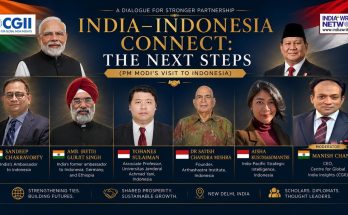
(Sandeep Chakravorty is India’s Ambassador to Indonesia. These remarks were delivered by him at a panel discussion, titled “India-Indonesia Connect: The Next Steps,” organised by Centre for Global India Insights, a think tank focused on global affairs, and India and the World magazine.)
The panel discussion was moderated by Manish Chand, CEO, CGII. The discussion featured prominent speakers, including Amb. Chakravorty, Amb. (Retd) Gurjit Singh, India’s former ambassador to Indonesia; Satish Chandra Mishra, Founder & Executive Director, Arthashastra Institute, Indonesia; Yohanes Sulaiman, Associate Professor in the Department of International Relations, Universitas Jenderal Achmad Yani, Indonesia; and Aisha Kusumasomantri, Director of Cooperation and External Affairs, Indo-Pacific Strategic Intelligence, Indonesia.
Author Profile

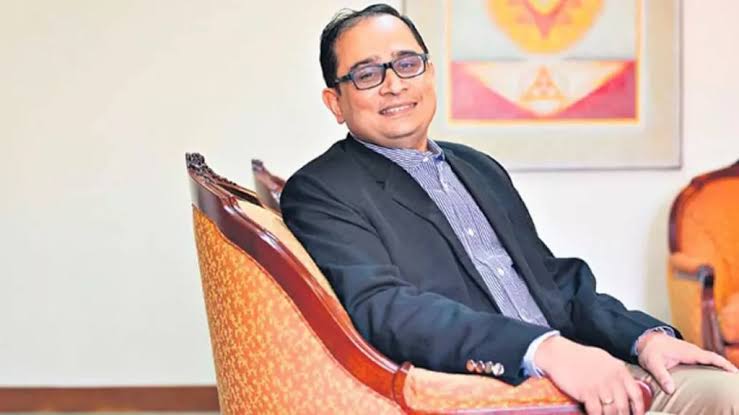
- Manish Chand is Founder and Editor-in-Chief of India Writes Network (www.indiawrites.org) and India and World, a pioneering magazine focused on international affairs. He is CEO, Centre for Global India Insights, an India-based think tank focused on global affairs.
Latest entries
 India and the WorldSeptember 13, 2026BRICS transcends Gulf divide, pitch for UN fast-tracking reforms
- DiplomacySeptember 13, 2026BRICS bonding bolsters India-Vietnam ties
- India and the WorldSeptember 11, 2026Decoding India’s BRICS moment: Forging an Inclusive World
- In ConversationSeptember 9, 2026India’s BRICS Chairship Critical for Global South: South Africa’s Envoy